How to Choose Safety Shoes for Work in Kenya
Choosing the right safety shoes is not simply about buying the strongest-looking boot or selecting the cheapest option available.
Workers in warehouses, manufacturing plants, engineering workshops, construction sites, logistics operations and other workplaces can face very different foot hazards. The appropriate protective footwear therefore depends on the job, workplace hazards, required protection, correct fit and documented specification of the exact footwear model.
This guide explains how to choose safety shoes for work in Kenya, the main footwear types available, important specifications to check and common mistakes to avoid.
If you are ready to compare available products and current prices, visit our Safety Shoes in Kenya page.
Why Safety Footwear Matters at Work
Protective footwear forms part of a wider workplace safety system.
Kenya’s Occupational Safety and Health framework places duties on employers to provide and maintain safe working conditions. Section 101 of the Occupational Safety and Health Act specifically addresses suitable protective clothing and footwear in workplaces involving exposure to wet or injurious or offensive substances. The appropriate PPE requirement therefore depends on the actual workplace conditions and risks.
Safety footwear may be considered where workers face hazards such as:
- Falling or moving materials
- Material handling
- Sharp objects underfoot
- Machinery and equipment
- Wet working conditions
- Particular floor surfaces
- Outdoor terrain
- Chemicals or other workplace substances
- Other job-specific foot hazards
The first step should therefore be understanding the hazard rather than choosing footwear by appearance.
Safety Shoes vs Safety Boots
The terms safety shoes and safety boots are sometimes used interchangeably, but there is a useful practical distinction.
Safety Shoes
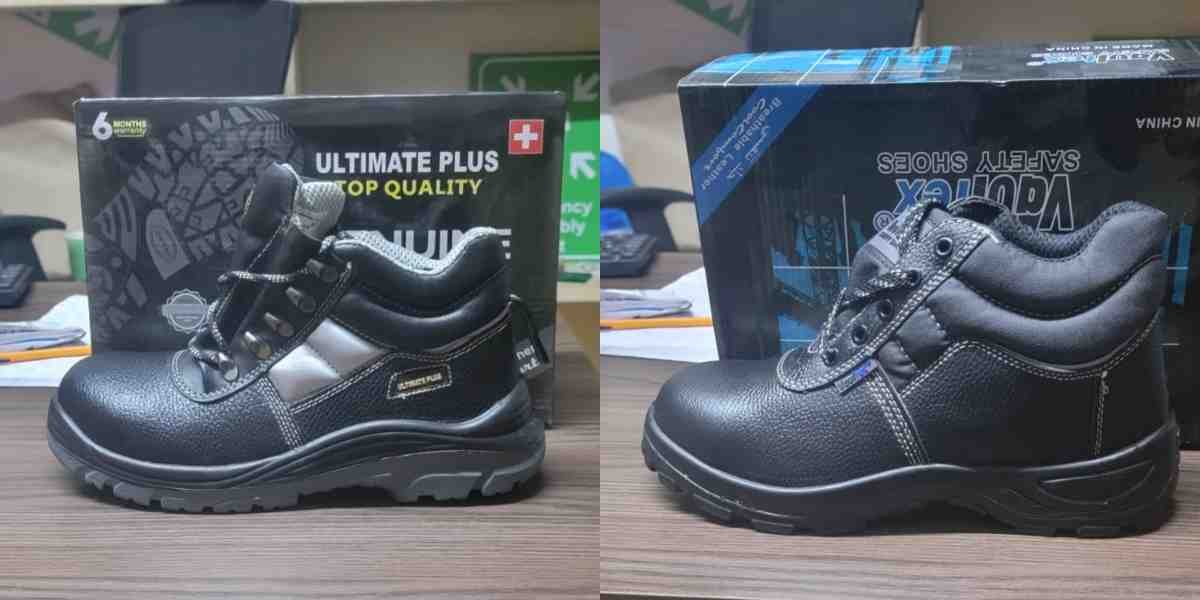
Safety shoes generally have a lower-cut profile around the ankle.
They may be appropriate for selected:
- Warehouses
- Manufacturing facilities
- Logistics operations
- Workshops
- Engineering teams
- Maintenance personnel
- Technical workers
- Supervisory roles
Safety Boots
Safety boots generally extend higher around the ankle.
They may be preferred for suitable:
- Construction work
- Outdoor operations
- Engineering projects
- Heavy industrial environments
- Workshops
- Maintenance work
- Rougher terrain
Footwear height alone does not determine its protection.
If you need high-cut protective footwear, browse our Safety Boots in Kenya collection.
Types of Safety Shoes and Protective Footwear
Different protective footwear models are designed for different workplace requirements.
1. Steel Toe Safety Shoes
Some safety shoes contain a steel protective toe cap intended to provide toe protection according to the particular footwear specification.
They may be considered where workers face relevant impact or compression hazards from:
- Materials
- Components
- Tools
- Stock
- Equipment
- Other falling or moving objects
Do not assume that having a steel toe automatically means a shoe also provides penetration resistance, electrical protection, waterproofing or chemical resistance.
Each property should be verified separately.
2. Composite or Non-Metallic Toe Safety Shoes
Some protective footwear uses non-metallic toe-cap materials rather than steel.
These can provide another protective-toe option depending on the model.
However, an important purchasing mistake is assuming:
Composite toe = electrical protection.
That is not automatically true.
Electrical performance requires the appropriate documented footwear specification. The toe-cap material alone should not be used to determine whether footwear is appropriate for electrical hazards.
3. Low-Cut Industrial Safety Shoes
Low-cut safety shoes provide a shoe-style profile and may suit workplaces where employees require protective footwear without the height of a traditional work boot.
They can be useful for suitable:
- Warehouse operations
- Logistics teams
- Manufacturing employees
- Technicians
- Engineering staff
- Workshops
- Maintenance personnel
Protection still varies considerably between individual models.
4. Women’s Safety Shoes
Protective footwear should fit the individual worker.
Women working in factories, warehouses, engineering, logistics, construction and other workplaces should have access to footwear in appropriate sizes and fit profiles rather than simply being issued oversized footwear.
Selected women’s protective footwear is available depending on current model and size availability.
5. Safety Gumboots
Conventional safety shoes are not the correct solution for every workplace.
Wet, muddy, agricultural, wash-down or other water-exposed environments may require suitable gumboots instead.
Some gumboot models may also contain additional protective features, but these should be verified against the exact product.
Explore our Safety Gumboots range for available options.
Step 1: Identify the Work Being Performed
Do not choose safety footwear from the worker’s job title alone.
Instead of saying:
“I need boots for a technician.”
identify what that technician actually does.
For example:
- Do they handle heavy components?
- Work around machinery?
- Walk on wet floors?
- Work outdoors?
- Encounter sharp objects?
- Work around chemicals?
- Spend most of the shift walking?
- Work on smooth warehouse floors?
Two employees with similar job titles can require different footwear.
Step 2: Identify the Foot Hazards
Once the job is understood, identify the hazards the footwear is intended to address.
Consider:
Impact and Compression
Could materials, equipment or other objects affect the worker’s toes?
Underfoot Hazards
Could the employee step on nails, sharp metal or similar objects?
Floor Conditions
Are floors smooth, wet, oily, uneven or exposed to outdoor conditions?
Water Exposure
Will the footwear regularly be used in rain, water, mud or wash-down conditions?
Chemical Exposure
Will employees come into contact with cleaning agents, solvents, oils, pesticides or other chemicals?
Electrical Hazards
Does the workplace risk assessment require footwear with a specific electrical rating?
This process helps determine what footwear specification is actually required.
Step 3: Check Toe Protection
Do not assume every product described as a safety shoe has the same toe protection.
Where protective toe caps are required, confirm:
- Toe-cap type
- Applicable documented standard
- Product model
- Intended application
- Relevant manufacturer information
A steel toe is one feature of a safety shoe—not evidence that the footwear provides every other type of protection.
Step 4: Check Underfoot Protection
Where workers may encounter nails or other penetrating objects, underfoot protection can become important.
Do not assume that a thick-looking sole automatically provides penetration resistance.
Confirm whether the exact model has the required protective midsole or documented penetration-protection properties.
Step 5: Check the Outsole
The outsole should be considered in relation to the actual workplace surface.
Workers may operate on:
- Smooth warehouse floors
- Concrete
- Workshop surfaces
- Wet areas
- Outdoor terrain
- Loading bays
- Production floors
Where slip resistance, oil resistance, heat resistance or another sole property is required, check the specification of the exact footwear.
Avoid assuming all industrial shoes have the same outsole performance.
Step 6: Be Careful With Waterproof Claims
One of the most common mistakes when buying work footwear is assuming a boot is waterproof because it looks heavy-duty.
There is also a difference between:
water resistant
and
waterproof.
Where employees regularly work in wet conditions, confirm the actual manufacturer’s description of the footwear.
For heavy water, mud or wash-down exposure, suitable gumboots may sometimes be more appropriate.
Step 7: Be Careful With Electrical Footwear Claims
Do not select footwear for electrical hazards simply because it:
- Has a composite toe
- Has a rubber-looking sole
- Contains less visible metal
- Is marketed informally as an electrician shoe
Electrical-hazard footwear requires appropriate documented performance for the particular application.
Where electrical hazards exist, the workplace requirement and exact footwear documentation should be reviewed carefully.
Step 8: Consider Chemical Exposure Separately
Ordinary industrial safety shoes should not automatically be treated as chemical-resistant footwear.
Workers handling:
- Cleaning chemicals
- Acids
- Solvents
- Oils
- Pesticides
- Industrial chemicals
may need footwear selected according to the actual substance and exposure conditions.
Chemical compatibility should not be inferred simply from the material’s appearance.
Step 9: Verify the Required Safety Standard
If an employer, contractor, tender or project specifies a footwear standard, check it against the exact product.
Do not assume compliance because of:
- Brand
- Price
- Country of manufacture
- Appearance
- Toe-cap material
- A generic product description
Where standards such as EN ISO 20345 are specified, verify the exact model and classification from appropriate product documentation.
Step 10: Check Fit and Sizing
Safety footwear that provides the correct protection but fits poorly can still create problems for the wearer.
Consider:
- Correct shoe size
- Toe space
- Foot width
- Normal work socks
- Standing comfort
- Walking comfort
- Normal work movements
Do not automatically advise workers to choose an oversized shoe simply for comfort.
Company Size Schedules
Companies purchasing footwear for several employees should prepare a size schedule.
For example:
| Size | Quantity |
|---|---|
| 39 | 4 |
| 40 | 8 |
| 41 | 12 |
| 42 | 14 |
| 43 | 8 |
| 44 | 4 |
This is more useful than submitting only a total quantity.
For workforce requirements, visit our Bulk Safety Boots Supplier in Kenya page.
Choosing Safety Shoes for Warehouses
Warehouse employees may spend many hours:
- Walking
- Standing
- Picking
- Packing
- Receiving stock
- Loading
- Dispatching
- Handling materials
Footwear selection should consider the worker’s role, material-handling hazards, floor conditions, required toe protection and correct fit.
Lower-cut safety shoes can be useful for some warehouse roles where their documented protection meets the workplace requirement.
Choosing Safety Shoes for Manufacturing
A factory can contain several very different work environments.
Footwear requirements may vary between:
- Machine operators
- Maintenance technicians
- Production workers
- Stores teams
- Warehouse employees
- Engineers
- Supervisors
Do not automatically issue one footwear model to every department without considering the actual risks.
Choosing Safety Footwear for Construction
Construction sites may involve:
- Falling materials
- Sharp debris
- Uneven terrain
- Tools
- Machinery
- Outdoor conditions
Higher-cut safety boots may be preferred for many construction applications, although the exact requirement should follow the site risks and project specification.
For wider site protection, visit our Construction PPE Kenya page.
Choosing Safety Shoes for Engineering and Workshops
Mechanics, fabricators, engineers and maintenance technicians can encounter:
- Machinery
- Metal components
- Tools
- Different floor conditions
- Material-handling risks
- Oils and other workplace substances
Select footwear according to these actual hazards rather than simply searching for a generic “engineering boot.”
Safety Shoes Price in Kenya
Safety shoe prices vary depending on:
- Brand
- Model
- Materials
- Construction
- Protective specification
- Size
- Availability
Because prices change, this article should not use old fixed 2025 price ranges.
For current price examples, see our Safety Boots Price in Kenya 2026 guide.
The better buying sequence is:
Hazard → Required Protection → Suitable Footwear → Specification → Fit → Price
not:
Price → Footwear
Common Mistakes When Buying Safety Shoes
Choosing Only by Price
The cheapest product may not provide the required workplace protection.
Price should be compared only after suitable footwear has been identified.
Assuming Every Safety Shoe Is Certified the Same Way
Different models can have different standards and classifications.
Check the exact product documentation.
Assuming Steel Toe Means Full Protection
Toe protection and penetration resistance are different properties.
Assuming Composite Toe Means Electrical Protection
Toe-cap material alone does not establish electrical-hazard performance.
Assuming Every Safety Shoe Is Waterproof
Waterproof performance should be confirmed for the exact model.
Buying the Same Size for Everyone
Employees require appropriate individual sizing.
Choosing by Appearance
A rugged-looking shoe does not prove any particular safety performance.
What Companies Should Include in a Safety Footwear RFQ
For company, contractor or project purchases, provide:
- Worker role
- Workplace environment
- Identified hazards
- Required footwear type
- Required technical specification
- Applicable standard where required
- Preferred brand or model if mandatory
- Employee size breakdown
- Quantity
- Delivery location
- Required date
A more complete requirement makes it easier to compare appropriate products and quotations.
Bansi Safety Gear’s procurement guidance also recommends including product specifications, quantities, employee sizes, delivery locations and required dates when preparing PPE requirements.
Where to Buy Safety Shoes in Kenya
Bansi Safety Gear supplies safety footwear and other workplace PPE for individual, company and project requirements.
Our physical shop is located at:
Imani Place, Kihunguro, Ruiru – next to Mark Hotel
Customers can contact the shop before visiting to confirm a particular model, size or quantity.
Phone / WhatsApp: 0797 619 609
General email: info@bansisafetygear.co.ke
Procurement email: procurement@bansisafetygear.co.ke
These are the current contact details published by Bansi Safety Gear.
For current safety-shoe products, visit our Safety Shoes in Kenya page.
For company and project requirements, Request a PPE Quotation.
Frequently Asked Questions About Choosing Safety Shoes
What should I check first when buying safety shoes?
Start with the worker’s job and workplace hazards. Once the required protection is understood, compare suitable footwear models, specifications, fit and price.
Are steel toe shoes suitable for every workplace?
No. Steel toe protection addresses specific toe hazards, but workplaces may have different requirements.
Are composite toe shoes electrically safe?
Not automatically. Electrical performance should be confirmed through the appropriate specification for the exact footwear.
Do safety shoes protect against nails?
Only where the footwear has suitable documented penetration protection. Do not assume this simply from outsole thickness.
Are all safety shoes waterproof?
No. Waterproof or water-resistant performance varies by model.
Should warehouse workers use safety shoes or boots?
Either may be appropriate depending on material-handling hazards, floor conditions, worker duties and required protection. Lower-cut shoes may suit some warehouse applications.
How should companies order different footwear sizes?
Prepare a workforce size schedule showing the quantity needed for each size.
Where can I compare safety shoes and current prices?
Visit our Safety Shoes in Kenya commercial page for current safety-shoe options, or the Safety Boots Price in Kenya 2026 guide for price information.
Final Safety Shoe Buying Checklist
Before ordering safety footwear, check:
- What job will the worker perform?
- What foot hazards are present?
- What toe protection is required?
- Is penetration protection required?
- What are the floor conditions?
- Is water exposure relevant?
- Are chemicals present?
- Is specialist electrical protection required?
- Is a particular standard specified?
- Is the correct size available?
- Does the exact product documentation support the required features?
- What is the current price and availability?
The most useful approach is:
Job → Hazard → Protection → Specification → Fit → Price
Once you have identified the footwear requirement, browse our Safety Shoes in Kenya page to compare current options.
Bansi Safety Gear — Gear Up. Stay Safe. Get It Done.

Leave a Reply