
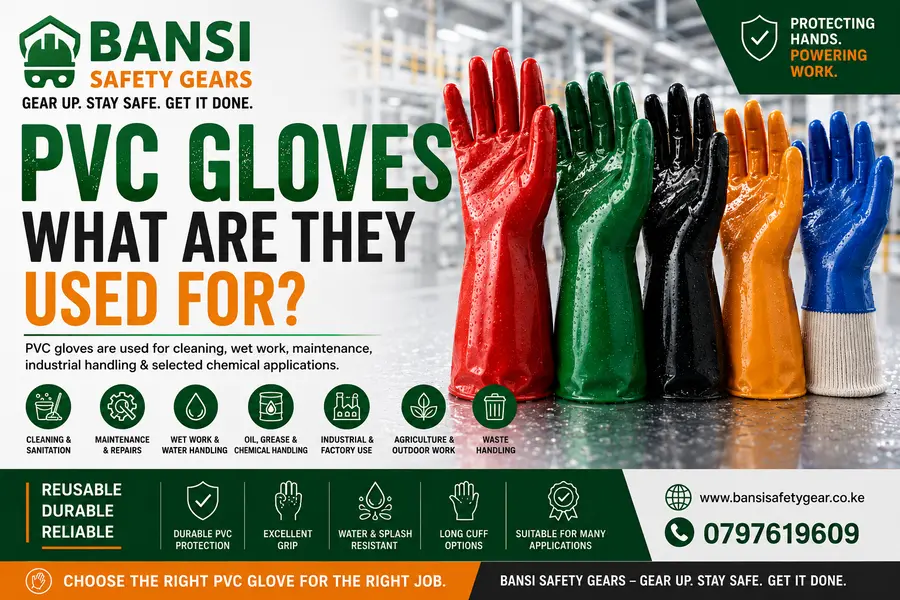
Are PVC Gloves Chemical Resistant?
PVC gloves can be chemical resistant, but they are not suitable for every chemical. Their level of protection depends on the specific PVC formulation, glove thickness, chemical involved, concentration, temperature and duration of exposure.
PVC, or polyvinyl chloride, is commonly used in reusable protective gloves for cleaning, wet work, industrial maintenance and selected chemical-handling applications. However, workers should never assume that a glove is safe for a chemical simply because it is made from PVC.
For available glove types and applications, visit our PVC Gloves in Kenya guide.
Are PVC Gloves Good for Chemicals?
PVC gloves can provide useful resistance against selected chemicals and workplace substances, depending on the individual glove specification.
They may be considered for certain:
- Cleaning chemicals
- Industrial solutions
- Detergents
- Oils and greasy substances
- Process liquids
- Maintenance chemicals
- Chemical handling tasks
- Wet industrial processes
But chemical resistance varies considerably.
A glove that performs well against one substance may provide poor protection against another.
For chemical-focused glove options, explore our PVC Chemical Resistant Gloves Kenya page.
What Determines PVC Glove Chemical Resistance?
Several factors determine whether a PVC glove is suitable for a chemical.
1. The Exact Chemical
Chemical names matter.
It is not enough to say that a worker is handling an “acid,” “solvent,” “cleaner” or “industrial chemical.”
Different chemicals within the same general group can interact very differently with PVC.
2. Chemical Concentration
Concentration can influence how aggressively a substance affects glove material.
A glove suitable for one concentration should not automatically be assumed suitable for a stronger formulation.
3. Exposure Duration
A brief splash and continuous chemical contact are very different exposure conditions.
Longer contact may increase the chance of the chemical passing through or degrading the glove.
4. Glove Thickness
PVC gloves are manufactured in different thicknesses.
Thickness can influence durability and chemical performance, although thicker does not automatically mean suitable for every chemical.
5. PVC Formulation
Not every PVC glove uses exactly the same material formulation.
Different manufacturers and glove designs may therefore have different chemical-resistance characteristics.
6. Temperature
Higher temperatures can change the way chemicals interact with glove materials.
Chemical compatibility information should therefore be considered together with actual working conditions.
Chemical Resistance Is Not the Same as Waterproofing
One important distinction is that waterproof does not automatically mean chemical resistant.
A glove may successfully prevent water from reaching the skin but still be unsuitable for a particular chemical.
For wet-work guidance, read PVC Gloves for Water and Wet Work Kenya.
You can also visit our Are PVC Gloves Waterproof? guide.
PVC Gloves for Chemical Handling
PVC gloves may be suitable for selected chemical-handling operations where compatibility has been verified.
Possible applications may include:
- Handling chemical containers
- Equipment cleaning
- Industrial washing
- Maintenance
- Chemical processing support
- Cleaning operations
- Selected waste-handling activities
Before selecting gloves, identify the exact substance and check the glove manufacturer’s compatibility information.
Read our dedicated PVC Gloves for Chemical Handling Kenya guide.
Long PVC Chemical Resistant Gloves
Chemical exposure is not always limited to the hands.
Where splashing may extend beyond the wrist, long PVC gloves can provide additional cuff and lower-forearm coverage.
Long gloves may be useful for suitable:
- Chemical container handling
- Industrial cleaning
- Equipment washing
- Wet processing
- Maintenance
- Splash-prone work
However, a longer glove is not automatically more chemically resistant. The glove material still needs to be compatible with the substance involved.
Explore our Long PVC Gloves Kenya page.
PVC Gauntlet Gloves for Chemical Work
PVC gauntlet gloves feature extended cuffs that can increase coverage around the wrist and forearm.
They may be considered for selected chemical-handling applications where:
- Splashing is possible
- Additional forearm coverage is needed
- Workers handle wet equipment
- Industrial cleaning is involved
Learn more from our PVC Gauntlet Gloves Kenya guide.
Heavy Duty PVC Chemical Gloves
Heavy-duty PVC gloves may provide more robust construction for demanding industrial applications.
They may be considered for selected:
- Chemical plant cleaning
- Factory maintenance
- Equipment cleaning
- Industrial washing
- Waste handling
- Repetitive wet work
However, heavy-duty does not mean universal chemical protection.
Chemical compatibility must still be verified.
Visit our Heavy Duty PVC Gloves Kenya page.
Are Red PVC Gloves Chemical Resistant?
Some red PVC gloves may be designed for chemical-handling applications, while others may primarily be intended for cleaning, wet work or general industrial use.
The colour of the glove does not determine:
- Chemical resistance
- Permeation performance
- Glove thickness
- Material formulation
- Intended application
Always check the actual product specification.
Explore our Red PVC Gloves Kenya guide.
Are PVC Gloves Acid Resistant?
Some PVC gloves may provide resistance against certain acidic substances, but it would be unsafe to describe all PVC gloves as acid-resistant gloves.
Suitability depends on:
- Type of acid
- Concentration
- Temperature
- Exposure duration
- PVC formulation
- Glove thickness
- Manufacturer chemical-resistance information
If acid protection is required, verify the exact glove against the exact chemical before use.
Are PVC Gloves Resistant to Alkalis?
PVC gloves may provide useful resistance to selected alkaline substances depending on their formulation and the working conditions.
As with acids, suitability should be verified against:
- Exact substance
- Concentration
- Temperature
- Exposure duration
- Manufacturer compatibility data
Do not rely only on the general material name.
Are PVC Gloves Solvent Resistant?
PVC should not be assumed to resist all solvents.
Certain solvents may significantly affect PVC glove material.
Where solvents are involved, workers should consult the specific chemical-resistance information supplied for the glove and choose a different glove material if PVC is not appropriate.
Are PVC Gloves Oil Resistant?
Some PVC gloves can be useful around oils, grease and lubricants, depending on their formulation.
They may be considered for suitable:
- Machinery maintenance
- Workshop work
- Factory maintenance
- Handling greasy components
- Equipment cleaning
However, oils, fuels, solvents and petroleum-related products are not all the same.
Read our PVC Gloves for Oil and Grease Handling Kenya guide.
PVC Gloves for Cleaning Chemicals
Cleaning is a common application for PVC gloves, but cleaning products vary substantially.
Workers may encounter:
- Detergents
- Degreasers
- Disinfecting products
- Industrial cleaners
- General cleaning solutions
A glove suitable for routine wet cleaning may not necessarily be suitable for a concentrated industrial cleaning chemical.
Visit our PVC Gloves for Cleaning Kenya guide.
For more demanding applications, see PVC Gloves for Industrial Cleaning Kenya.
PVC Gloves for Chemical Plants
Chemical plants may involve many different substances and exposure conditions.
PVC gloves may be appropriate for selected operations where their compatibility has been confirmed.
Potential uses may include:
- Equipment cleaning
- Maintenance
- Chemical handling
- Wet processing
- Container handling
- Industrial washing
Visit our PVC Gloves for Chemical Plants Kenya guide.
Understanding Permeation, Penetration and Degradation
When assessing chemical gloves, three concepts are important.
Permeation
A chemical may move through the glove material at a molecular level even when there is no visible hole.
Penetration
Liquids can pass through holes, defects, seams or other physical openings.
Degradation
Chemical exposure may physically alter the glove material.
Possible warning signs include:
- Swelling
- Softening
- Hardening
- Cracking
- Stickiness
- Discoloration
- Loss of flexibility
This is why appearance alone cannot prove that a glove remains chemically protective.
What Is Chemical Breakthrough Time?
Chemical breakthrough time generally refers to how long it takes for a chemical to permeate through a glove material under specified test conditions.
This information can be useful when comparing gloves for chemical work.
However, real workplace conditions may differ from laboratory conditions, so breakthrough information should be considered together with manufacturer guidance and the workplace risk assessment.
How to Choose PVC Gloves for Chemicals
When selecting PVC gloves for chemical work:
Identify the Exact Chemical
Do not select gloves based only on a broad chemical category.
Check Concentration
Know the concentration workers will encounter.
Determine Contact Type
Consider whether exposure involves:
- Occasional splash
- Repeated contact
- Prolonged contact
- Immersion
Check Manufacturer Compatibility Information
Use chemical-resistance information for the specific glove model.
Select the Correct Length
Long cuffs may be needed where splash exposure extends above the wrist.
Consider Dexterity
Workers still need to safely operate tools, containers and equipment.
Check Fit
Correct fit improves glove control and comfort.
For broader glove-selection advice, visit our How to Choose PVC Gloves guide.
PVC Gloves vs Nitrile Gloves for Chemicals
PVC and nitrile gloves have different chemical-resistance properties.
Neither material is automatically better for every chemical.
Selection should depend on:
- Exact substance
- Concentration
- Exposure duration
- Glove formulation
- Thickness
- Required dexterity
- Manufacturer resistance information
Read our PVC Gloves vs Nitrile Gloves comparison.
Inspect PVC Chemical Gloves Before Use
Chemical-handling gloves should be inspected carefully.
Look for:
- Cuts
- Tears
- Punctures
- Cracking
- Swelling
- Softening
- Hardening
- Sticky surfaces
- Unusual discoloration
- Damaged cuffs
- Material deterioration
A glove that has degraded should not continue to be relied upon for chemical protection.
Read our How to Inspect PVC Gloves guide.
Can Chemical Resistant PVC Gloves Be Reused?
Some chemical-resistant PVC gloves are designed for reuse, but reuse depends on the product and exposure.
Before reuse, consider:
- Manufacturer instructions
- Chemical involved
- Exposure duration
- Decontamination requirements
- Glove condition
- Signs of degradation
A glove should not be reused merely because no hole is visible.
Read our Can PVC Gloves Be Reused? guide.
Are PVC Gloves Chemical Resistant? The Key Point
PVC gloves can provide chemical resistance against selected substances, but there is no universal PVC glove suitable for every chemical.
The safest selection process is:
Chemical → Concentration → Exposure → Compatibility → Glove Type → Cuff Length → Inspection
Do not choose chemical gloves based only on:
- Colour
- Thickness
- Length
- Price
- PVC material name
The actual glove specification matters.
Find PVC Chemical Resistant Gloves in Kenya
Bansi Safety Gear offers PVC gloves in Kenya for selected cleaning, industrial, maintenance, wet-work and chemical-handling applications.
Available options may include long PVC gloves, PVC gauntlets, heavy-duty PVC gloves, reusable PVC gloves and chemical-resistant designs.
When chemical protection is required, choose according to the exact chemical and manufacturer compatibility information.
Explore our PVC Chemical Resistant Gloves Kenya range or return to our main PVC Gloves in Kenya guide.
Bansi Safety Gear – Gear Up. Stay Safe. Get It Done.




Comments (3)
[…] our Are PVC Gloves Chemical Resistant? […]
[…] our Are PVC Gloves Chemical Resistant? […]
[…] our Are PVC Gloves Chemical Resistant? […]