How to Identify a Genuine KN95 Mask in Kenya
Buying a respirator simply because “KN95” is printed on the mask is not enough.
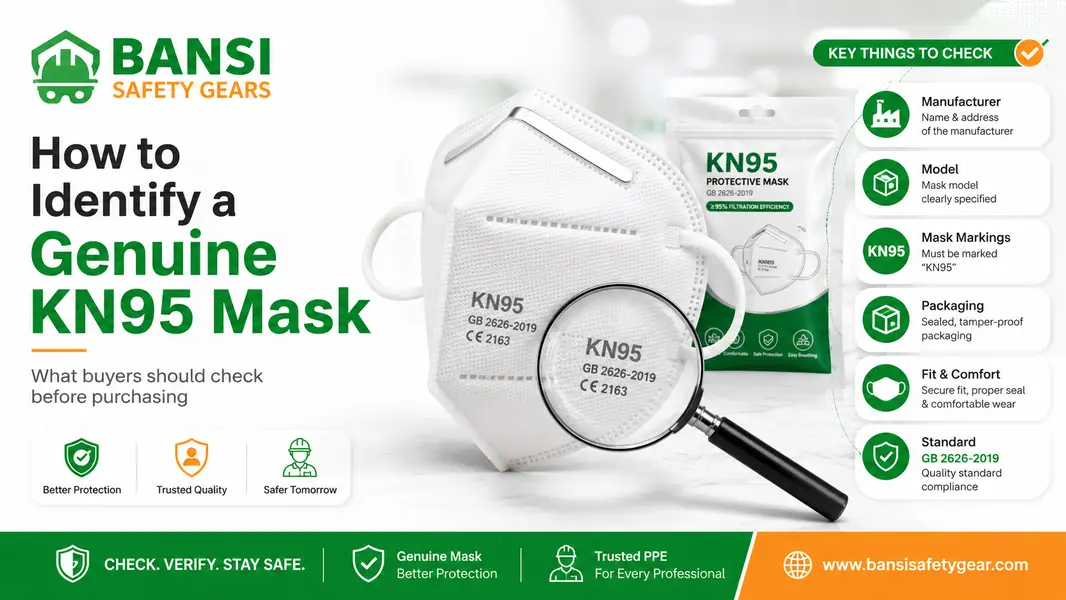
If you want to know how to identify a genuine KN95 mask, check the complete product rather than relying on appearance alone.
Important checks include:
- Manufacturer
- Exact model
- KN95 marking
- Applicable standard
- Packaging
- Product documentation
- Physical condition
- Supplier information
- Fit
- Intended application
This is particularly important for companies purchasing respiratory PPE for employees because a counterfeit, incorrectly labelled or misrepresented respirator may not provide the protection expected.
Important: No single visual feature can prove that a KN95 respirator is genuine.
For products currently listed by Bansi Safety Gear, browse KN95 Masks in Kenya.
What Does KN95 Mean?
KN95 is a particulate-respirator classification associated with China’s respiratory-protection standards.
One standard buyers may encounter is:
GB 2626-2019
Your existing page identifies this as the Chinese national standard for non-powered air-purifying particle respirators.
The important point is:
KN95 is a technical classification, not simply a product name or marketing phrase.
Therefore, a mask should not be accepted purely because KN95 appears on:
- The facepiece
- The packaging
- A website listing
- A supplier quotation
The marking is only one part of product verification.
1. Check the Manufacturer
Start by identifying who actually manufactured the respirator.
A KN95 intended for workplace procurement should have enough information to identify the product and its source.
Check for information such as:
- Manufacturer name
- Brand
- Product model
- Product description
- Applicable standard
- Batch or production information where supplied
- User instructions
- Manufacturer or traceability information
Anonymous packaging with little useful product information should prompt additional verification before a large purchase is approved.
2. Confirm the Exact Model
Do not approve a respirator using only the description:
“KN95 Mask”
Different products from the same manufacturer can have different specifications.
For controlled procurement, record something closer to:
Manufacturer → Model → KN95 Specification → Packaging
The exact model becomes particularly important when:
- Approving respiratory PPE
- Comparing supplier quotations
- Creating an approved-product list
- Placing repeat orders
- Reviewing technical documentation
- Receiving bulk deliveries
Your existing page already makes this important procurement distinction.
3. Check the Applicable Standard
Look for the respiratory standard claimed for the exact product.
A KN95 respirator may reference GB 2626-2019 on the mask, packaging or accompanying product information.
However, a standard number printed on a box is not automatic proof that the product genuinely complies with that standard.
Use the claimed standard as one verification point.
Then compare it with:
- Manufacturer
- Model
- Mask markings
- Packaging
- Datasheet
- Available conformity or testing information
4. Inspect the KN95 Markings
Inspect the respirator itself.
Product markings should be clear enough to help identify what you are buying.
Depending on the exact manufacturer and model, relevant information may include:
KN95 classification → manufacturer or brand → model → standard or other product identification
Poor printing does not automatically prove a respirator is counterfeit.
However, investigate further if markings are:
- Missing
- Inconsistent
- Difficult to identify
- Different from the packaging
- Different from the quoted model
For company procurement, approve the actual product being offered, not only a generic catalogue photograph.
5. Inspect the Packaging
Packaging can provide valuable product-identification and traceability information.
Check whether it:
- Identifies the manufacturer
- Identifies the model
- Matches the respirator inside
- Shows the claimed specification
- Contains instructions where applicable
- Is properly sealed
- Is not badly damaged
- Matches the product offered in the quotation
One particularly useful question for bulk procurement is:
Will the delivered product be the exact same manufacturer, model and packaging as the product submitted for approval?
This helps reduce the risk of an approved sample being replaced with a different product at delivery.
6. Match the Mask, Packaging and Documents
When supporting documentation is supplied, compare it with the actual mask.
The following should logically correspond:
Respirator → Packaging → Manufacturer → Model → Datasheet → Technical Documents → Supplier Quotation
If one document identifies a different:
- Manufacturer
- Brand
- Model number
- Product code
- Standard
ask for clarification before approval.
A certificate or test document relating to one model should not automatically be applied to another product.
This becomes particularly important when buying hundreds or thousands of masks.
7. Do Not Confuse KN95 With NIOSH-Approved N95
This is one of the most important verification points.
KN95 does not automatically mean NIOSH-approved N95.
Your existing article correctly explains that NIOSH-approved filtering facepiece respirators carry specific identification such as the approval holder or manufacturer, model information, classification, NIOSH marking and an approval number.
Therefore, if a supplier tells you:
“This KN95 is NIOSH approved.”
do not rely on the statement alone.
Ask for:
- Exact manufacturer
- Exact model
- NIOSH approval details
- Approval number where applicable
Then verify the exact respirator.
For a deeper comparison, read N95 vs KN95 Masks in Kenya.
8. Be Careful With the Word “Certified”
Marketing words can sound technical without providing enough information.
Examples include:
- Certified
- Approved
- Tested
- Medical grade
- International standard
- Premium protection
- High filtration
A procurement officer should ask:
Certified to what standard?
Which exact product was tested?
Which manufacturer does the document identify?
Does the document show the same model being supplied?
Does the evidence actually support the marketing claim?
The word certified by itself is not enough.
9. Check Construction Quality
Visual inspection cannot prove filtration performance.
However, it can reveal obvious defects.
Inspect:
- Ear loops or head straps
- Nose bridge
- Seams
- Weld points
- Mask shape
- Filtering material
- Loose components
- Tears
- Contamination
- Packaging condition
Compare multiple masks from the same box or batch where appropriate.
Investigate products that show:
- Inconsistent construction
- Loose straps
- Damaged material
- Missing components
- Major shape differences
- Poorly attached valves
- Visible contamination
A damaged mask should not be issued simply because the package says KN95.
10. Check the Fit
A genuine respirator can still provide inadequate protection if it does not fit the wearer correctly.
A KN95 should sit closely around the:
Nose → Cheeks → Mouth → Chin
Look for obvious gaps around the sealing area.
The nose section should be adjusted correctly, and the mask should remain stable during normal movement.
Facial hair that crosses the sealing area may interfere with the fit of a close-fitting respirator.
11. Check Whether It Is Valved or Non-Valved
KN95 masks may be supplied in different physical designs.
Valved KN95
A valved KN95 includes an exhalation valve designed to make breathing out easier and may help reduce heat or moisture buildup.
Non-Valved KN95
A non-valved respirator has no dedicated exhalation valve.
The valve does not automatically determine whether a respirator is genuine.
Likewise, a valve does not automatically make one KN95 technically better than another.
The exact model and workplace requirement still matter.
Browse KN95 Masks in Kenya to compare current designs.
12. Foldable vs Cup KN95 Is Not an Authenticity Test
A genuine KN95 can be manufactured in different shapes.
Common designs include:
- Foldable respirators
- Cup-style respirators
- Valved respirators
- Non-valved respirators
Do not conclude that a mask is fake simply because it has a different physical design.
Verification should focus on the complete product.
Genuine KN95 Does Not Mean Suitable for Every Hazard
This distinction is essential.
A KN95 can be genuine and still be the wrong respirator for the job.
KN95 filtering facepieces are intended for suitable particulate hazards.
They should not automatically be selected for:
- Organic vapours
- Solvent vapours
- Acid gases
- Chemical gases
- Paint vapours
- Certain pesticide vapours
These applications may require a reusable respirator fitted with the appropriate compatible filter or cartridge.
Browse Chemical Respirators Kenya or the wider Respiratory Protection Kenya range.
KN95 Masks Do Not Supply Oxygen
A KN95 is an air-purifying filtering facepiece.
It does not supply breathing oxygen.
Do not rely on a KN95 for:
- Oxygen-deficient atmospheres
- Unknown atmospheres
- Immediately dangerous environments
- Unassessed confined spaces
These conditions may require atmospheric testing and specialist respiratory equipment.
Warning Signs That Need More Investigation
No single warning sign automatically proves a product is counterfeit.
However, investigate further if you find:
- No identifiable manufacturer
- No model information
- Product and packaging do not match
- Documentation identifies another model
- Technical claims cannot be explained
- “KN95” and “NIOSH N95” are treated as automatically identical
- NIOSH approval is claimed without supporting identifying information
- Different masks are mixed within the same packaging
- Product construction is unusually inconsistent
- Delivered product differs from approved sample
- Supplier refuses to identify the exact product
Your existing article appropriately treats these as reasons for further investigation rather than automatic proof of counterfeiting.
How Procurement Officers Should Approve KN95 Masks
For company procurement, use a repeatable process.
A useful sequence is:
Identify Hazard → Define Respirator Requirement → Manufacturer → Model → Standard → Product Markings → Documentation → Product Review → Fit Consideration → Quotation → Approval
This is considerably stronger than:
Lowest Price → KN95 Printed on Mask → Purchase
Once a respirator has been approved internally, record its exact manufacturer and model.
Then compare repeat orders with that approved reference.
KN95 Verification Checklist for Procurement
Before approving a larger KN95 order, check:
- Manufacturer identified
- Exact model identified
- KN95 marking checked
- Claimed standard checked
- Product matches packaging
- Documentation matches model
- Supplier quotation identifies correct product
- Packaging requirement confirmed
- Physical condition inspected
- Fit considered
- Workplace hazard confirmed
- Quantity confirmed
- Delivery requirement confirmed
This checklist does not guarantee authenticity by itself, but it creates a much stronger purchasing process.
Buying KN95 Masks Online in Kenya
Online photographs can help with product discovery, but they should not be the only basis for approving workplace respiratory PPE.
Before approving a significant order, identify:
Manufacturer → Brand → Model → Standard → Design → Packaging → Quantity
Where necessary, request available product information for technical review.
Browse KN95 Masks in Kenya for currently listed products.
Genuine KN95 vs Cheap KN95
Price alone cannot tell you whether a mask is genuine.
A lower selling price can result from:
- Different manufacturer
- Different packaging
- Larger order quantity
- Different sourcing arrangement
- Different commercial margin
- Different model
Likewise, an expensive respirator is not automatically genuine.
Use product verification rather than price as the primary authenticity check.
For current KN95 products and pricing, browse KN95 Masks Price in Kenya.
Buying KN95 Masks in Bulk
Companies ordering KN95 respirators in larger quantities should submit a clear technical requirement.
A strong RFQ can include:
Product Type → Standard → Manufacturer/Model if Mandatory → Valve Requirement → Quantity → Packaging → Documentation → Delivery Location → Required Date
Where alternatives are allowed, state the minimum technical requirements they must satisfy.
For corporate purchasing, visit Bulk KN95 Masks for Companies in Kenya.
For a formal requirement, Request a PPE Quotation.
Frequently Asked Questions
How can I tell if a KN95 mask is genuine?
Check the manufacturer, exact model, markings, claimed standard, packaging and supporting product information. No single visual feature alone proves authenticity.
Is every mask marked KN95 genuine?
No. The printed KN95 classification by itself should not be treated as proof that the exact respirator meets the claimed specification.
What does GB 2626-2019 mean?
It is a Chinese respiratory-protection standard associated with non-powered air-purifying particulate respirators. Where conformity is claimed, verify the exact product and available manufacturer information.
Does a KN95 need GB 2626-2019 printed on it?
Do not use one printed item as your only authenticity test. Review the complete product, packaging, manufacturer information and applicable documentation.
Is KN95 the same as NIOSH-approved N95?
No. KN95 and NIOSH-approved N95 respirators belong to different standards or approval systems.
How can I verify a NIOSH-approved N95?
Check the exact NIOSH markings, manufacturer, model and approval information and verify the product through the relevant NIOSH records.
Should I ask for KN95 certificates?
For workplace procurement, request applicable product or manufacturer documentation where required. Make sure the documents relate to the exact model being supplied.
Does expensive mean genuine?
No. Price alone does not prove authenticity.
Can packaging help identify a genuine KN95?
Yes. Packaging can provide manufacturer, model, standard and traceability information, but packaging alone does not prove performance.
Can a genuine KN95 still be unsafe for my job?
Yes. A genuine respirator must still match the actual workplace hazard and required protection level.
Do KN95 masks protect against chemical vapours?
KN95 particulate respirators should not automatically be used for gases or chemical vapours.
Can facial hair affect a genuine KN95?
Yes. Facial hair crossing the sealing surface can interfere with the fit of a tight-fitting respirator.
Can companies request a specific KN95 model?
Yes. Include the exact manufacturer and model in the RFQ where it is mandatory.
Can companies buy KN95 masks in bulk?
Yes. Companies and institutions can submit the quantity, specification, documentation and delivery requirements for quotation.
Buy Verified KN95 Masks in Kenya
For current products, browse KN95 Masks in Kenya.
For help choosing the appropriate type, read the KN95 Masks Kenya Guide.
To compare standards, read N95 vs KN95 Masks in Kenya.
For larger company quantities, visit Bulk KN95 Masks Kenya or Request a PPE Quotation.
Bansi Safety Gear — Gear Up. Stay Safe. Get It Done.


Leave a Reply