Safety Equipment Kenya – Bansi Safety Gear
Workplace safety depends on more than purchasing a few helmets, gloves or reflector jackets. The right safety equipment in Kenya should be selected according to the actual hazard, work activity, employee role and required level of protection.
Construction sites, factories, warehouses, farms, workshops, logistics operations and institutions can all require different combinations of personal protective equipment, emergency products, fire-safety equipment, signage and site-safety controls.
Bansi Safety Gear provides workplace safety products for individuals, companies, contractors and institutions. If your requirement is mainly wearable PPE, start with the PPE Safety Equipment in Kenya hub. This guide takes a broader look at workplace safety equipment, including PPE, fire safety, first aid, fall protection and site-safety products.
What Does Safety Equipment Include?
Safety equipment is a broad term covering products used to protect workers, control access to hazards, improve visibility, support emergency response and reduce workplace risk.
Depending on the workplace, safety equipment may include:
- Personal protective equipment worn by employees
- Fire-safety and emergency-response products
- First-aid equipment
- Safety signs and warning systems
- Traffic and site-control products
- Fall-protection equipment
- Spill-control and chemical-response products
- Workplace visibility and protective clothing
This is why safety equipment should not automatically be treated as exactly the same thing as PPE.
PPE protects the individual worker, while workplace safety equipment can also include products used around the workplace itself.
1. Head Protection
Head protection may be required where workers face falling objects, impact or other suitable head hazards.
The exact helmet or head-protection product should match the work environment, hazard and required specification.
Browse Safety Helmets in Kenya for available industrial and workplace helmet options.
2. Hand Protection
Gloves should be selected for the actual hand hazard.
Handling, cuts, abrasion, chemicals, heat, welding, wet work and food handling can require very different glove materials and performance characteristics.
Explore Safety Gloves and Hand Protection for workplace glove options.
When selecting gloves, consider:
- The material being handled
- Cut or abrasion risk
- Chemical exposure
- Heat or cold
- Required grip
- Dexterity
- Glove length
- Worker fit
3. Foot Protection
Safety footwear can help protect workers against workplace hazards involving impact, floor conditions, wet environments and other job-specific risks.
Correct sizing is especially important when companies are buying footwear for several employees.
Browse Safety Boots in Kenya for available work footwear.
When comparing safety boots, consider more than appearance or price. Depending on the job, the specification may need to consider toe protection, sole construction, penetration risk, workplace surfaces, boot height and fit.
4. Eye and Face Protection
Safety glasses, goggles and face protection may be required where workers face particles, dust, liquid splash, sparks or other eye and face hazards.
The correct product depends on the exposure.
Ordinary safety spectacles, sealed goggles and full face shields do not provide exactly the same type of protection.
See the Eye Protection range for suitable workplace options.
5. Respiratory Protection
Respiratory equipment should be selected according to the airborne hazard rather than by appearance alone.
Dust, particulates, gases and vapours are different hazards and may require different respirator systems, filters or cartridges.
Before buying respiratory protection, establish:
What is in the air? → What is the exposure? → What type of protection is required? → Which respirator or filter is suitable?
Explore Respiratory Protection for available masks and respirators.
6. Hearing Protection
Ear plugs and ear muffs are used in workplaces where noise exposure requires hearing protection.
The required product should be selected with workplace noise exposure, wearer fit, comfort and compatibility with other PPE in mind.
For example, helmet-mounted ear muffs should work correctly with the helmet system being used.
See our Hearing Protection range.
7. Protective and High-Visibility Clothing
Protective clothing can include reflective wear, overalls, rainwear, aprons and specialist garments.
The correct clothing depends on the job and exposure.
High-visibility clothing may be needed around moving vehicles, roadworks, construction traffic and low-visibility work environments.
Other protective clothing may be selected for wet work, chemical exposure, dirt, contamination or weather conditions.
Browse Protective Clothing for workplace clothing options.
8. Fall Protection Equipment
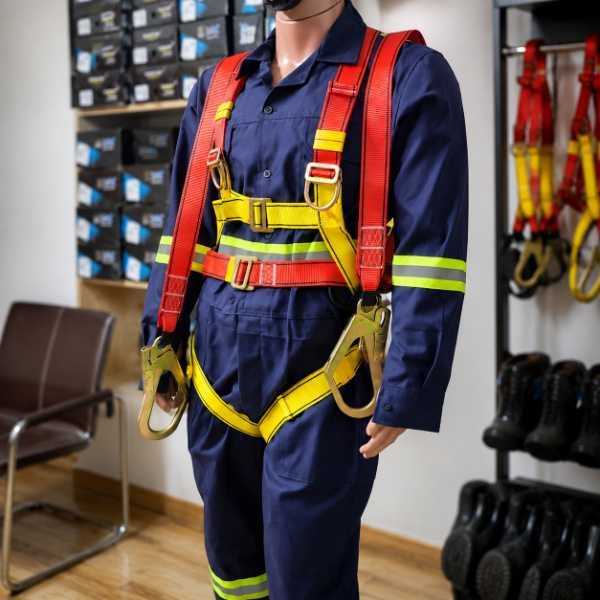
Working at height may require a complete fall-protection system rather than a harness alone.
Depending on the work, a system may include:
- Full-body harness
- Lanyard
- Energy absorber
- Connectors
- Lifeline
- Suitable anchorage
All components should be suitable for the intended work and compatible with one another.
Explore Fall Protection Equipment or read our Full Body Safety Harness Guide.
9. Fire Safety Equipment
Workplace fire safety may require different products depending on the premises, activities and fire-risk arrangements.
Typical equipment can include:
- Fire extinguishers
- Fire blankets
- Fire signage
- Emergency-response products
- Other suitable fire-safety equipment
The correct extinguisher should be selected for the type of fire hazard rather than simply purchasing whichever extinguisher is available.
Visit our Fire Safety Equipment in Kenya page for available fire-safety products.
10. First Aid and Emergency Equipment
First-aid equipment supports immediate workplace response when an employee is injured or becomes unwell.
The contents and size of a first-aid kit should reflect the workplace, number of people and organisation’s safety arrangements.
Depending on the workplace, businesses may also require additional emergency equipment for particular risks.
Browse First Aid Kits for workplace options.
11. Road, Traffic and Site Safety Equipment
Not every safety product is worn by a worker.
Road cones, barriers, warning signs, caution tape and visibility products can help organise vehicle and pedestrian movement around worksites and operational areas.
These products are particularly relevant for:
- Roadworks
- Construction sites
- Warehouses
- Loading areas
- Vehicle yards
- Maintenance work
- Temporary restricted areas
Explore Road and Site Safety Equipment for relevant products.
How to Choose the Right Safety Equipment
A workplace should not start with a catalogue and then decide which products look useful.
Start with the work being performed and the hazard that needs to be controlled.
A stronger selection process is:
Work Activity → Hazard → Exposure → Control Required → Equipment Specification → Worker Fit or Site Use
Before buying, ask:
- What task is being performed?
- What could injure the worker or other people?
- Can the hazard be eliminated or controlled before PPE is used?
- Which body area or workplace zone requires protection?
- What product type or material is required?
- Does a particular standard or rating apply?
- Will the equipment work correctly with other PPE?
- How will the equipment be inspected?
- How will it be maintained?
- When should it be replaced?
If your main question is specifically which PPE workers should wear, use our Personal Protective Equipment in Kenya selection guide.
Safety Equipment for Different Workplaces in Kenya
Different industries require different combinations of safety equipment.
Construction Sites
Construction requirements may include:
- Safety helmets
- Safety boots
- Work gloves
- Reflective clothing
- Eye protection
- Respiratory protection
- Fall protection
- Fire-safety equipment
- First-aid equipment
- Site signage
- Traffic-control products
The exact requirement should depend on the activities being performed.
Read our Essential Safety Items for Construction Sites in Kenya guide.
Manufacturing and Factories
Production teams, machine operators, maintenance employees and warehouse staff can require different safety equipment depending on machinery, materials, noise, chemicals, handling activities and movement around the facility.
A production employee may require very different protection from a maintenance technician working in the same factory.
The employee’s job role should therefore form part of the equipment-selection process.
Warehousing and Logistics
Common warehouse and logistics requirements may include:
- Safety footwear
- Handling gloves
- High-visibility clothing
- First-aid equipment
- Traffic-control products
- Warning signs
Additional equipment may be necessary depending on forklifts, vehicles, loading activities and materials being handled.
Agriculture and Flower Farms
Agricultural PPE requirements can change significantly from one activity to another.
Greenhouse work, pesticide handling, harvesting, packhouse operations and maintenance can involve completely different hazards.
For detailed sector guidance, visit our Flower Farm PPE Kenya hub.
Workshops and Engineering
Welding, grinding, fabrication, repair and maintenance work may require:
- Safety footwear
- Welding gloves
- Eye protection
- Face protection
- Hearing protection
- Respiratory protection
- Protective clothing
The final PPE combination should follow the actual process and exposure.
Cleaning and Facilities
Cleaning teams may require:
- Protective gloves
- Gumboots
- Aprons
- Eye protection
- Respiratory protection
- Warning signs
- Wet-floor controls
The exact requirement depends heavily on the cleaning chemical and the task being performed.
Standards and Product Specifications
Safety standards should be checked at the product level.
It is not safe to assume that every helmet, glove, boot or respirator from the same brand carries the same rating or is suitable for the same application.
Where a procurement requirement specifies a standard, protection class or performance level, include it clearly in the enquiry and verify the exact product model before approval.
Useful information to request can include:
- Exact product model
- Manufacturer information
- Applicable standard or test reference
- Protection class or rating
- Material
- Size
- Product limitations
- Care information
- Replacement guidance
For structured company requirements, visit our Procurement Information page.
Safety Equipment Brands Available
Some buyers have preferred brands, while others are open to suitable alternatives.
Bansi Safety Gear offers selected products from brands including:
- Vaultex
- Ultimate Plus
- Ace
- Safety Jogger
- Porcupine
Availability depends on the specific product, model, specification and current stock position.
You can explore Vaultex Safety Wear and Ultimate Plus Work Boots for selected branded ranges.
A brand should not replace specification checking. Different models from the same brand may be intended for different applications.
Buying Safety Equipment for a Company
Company procurement is easier when the requirement is prepared as a structured list rather than a collection of separate product enquiries.
For each item, include:
- Product name
- Required specification
- Brand or model where mandatory
- Size
- Quantity
- Delivery location
- Required date
For example:
Safety Boots – Size 42 – 20 pairs
Safety Helmets – White – 20 pieces
Reflective Jackets – XL – 20 pieces
Leather Gloves – 40 pairs
Safety Goggles – 20 pieces
Companies, contractors and institutions can submit multi-product requirements through our Request a PPE and Safety Equipment Quotation page.
Where to Buy Safety Equipment in Kenya
Bansi Safety Gear provides PPE and workplace safety products for individual, company and project requirements.
Customers can browse products online, send product enquiries, arrange collection or submit larger requirements for quotation.
For quick product discovery, visit Safety Gear Kenya.
For local buying, directions and collection around Nairobi and Ruiru, use Safety Shop Nairobi.
For wider PPE categories, brands, standards and company procurement, continue to PPE Safety Equipment in Kenya.
This creates a clearer buying route depending on what you need rather than comparing unrelated suppliers in a list.
Common Safety Equipment Buying Mistakes
Buying by Price Alone
Price matters, but first identify products that meet the required workplace protection and specification.
Compare price after suitability has been established.
Assuming All PPE Is Interchangeable
Similar-looking products can have different materials, ratings and intended applications.
Always check the exact product.
Ignoring Employee Sizes
Footwear, clothing, gloves and harnesses may depend on suitable sizing and fit.
Prepare a proper employee size schedule for larger orders.
Treating PPE as the Only Safety Control
PPE should form part of a wider approach to workplace risk control.
Where possible, hazards should also be addressed through suitable engineering, administrative and other workplace controls.
Buying Several Categories Without a Schedule
If a company needs boots, helmets, gloves, overalls and respirators, prepare one structured requirement containing every item, specification, size and quantity.
This makes quotation comparison and repeat purchasing easier.
Ignoring Replacement Planning
Safety equipment does not necessarily last forever.
Damaged, worn, contaminated or unsuitable equipment may need to be removed from service and replaced.
Businesses should consider replacement requirements when planning workplace PPE quantities.
Frequently Asked Questions About Safety Equipment in Kenya
What is workplace safety equipment?
Workplace safety equipment includes PPE worn by employees as well as fire-safety products, first-aid equipment, warning signs, traffic-control products, fall protection and other equipment used to reduce workplace risk.
Is PPE the same as safety equipment?
PPE is one part of safety equipment. Safety equipment is broader and can include non-wearable products such as fire extinguishers, first-aid kits, road cones and warning signs.
Where can I buy safety equipment in Kenya?
Bansi Safety Gear provides workplace safety products through its online catalogue, product enquiries, collection and formal quotation routes.
Can I buy safety equipment for one worker?
Yes. Selected products can be purchased for individual or small-team requirements depending on the particular product and availability.
Can companies buy several safety products together?
Yes. Multi-product requirements can be submitted together with quantities, sizes and specifications for quotation.
Do you sell safety boots?
Yes. Protective footwear is available for suitable construction, industrial, warehouse, workshop and field applications. Browse our Safety Boots range.
Do you sell safety helmets?
Yes. Safety helmet options are available for appropriate workplace head-protection requirements. Explore Safety Helmets in Kenya.
Do you sell respirators?
Yes. Respiratory-protection products are available, but the correct respirator should match the actual airborne hazard. Browse Respiratory Protection.
Do you sell fire-safety equipment?
Yes. Fire-safety products are available through our Fire Safety Equipment in Kenya range.
Do you sell first-aid kits?
Yes. First-aid kits are available for workplace and organisational requirements.
Can I request a specific PPE brand?
Yes. State the exact brand or model where required and indicate whether suitable alternatives may be considered.
Can you provide a formal quotation?
Yes. Companies, contractors and institutions can submit item lists, sizes, quantities, specifications and delivery details through the Request a Quotation page.
Can safety equipment be delivered?
Delivery arrangements can be discussed according to the confirmed order, product availability, quantity, destination and agreed terms.
How should I choose safety equipment?
Start with the work activity and hazard, then identify the required control, product specification, fit or site-use requirement before comparing products.
Should I check PPE standards before buying?
Where a particular standard or rating is required, verify it against the exact product model and available manufacturer information before approving the product.
Build a Safer Workplace With the Right Equipment
The right safety-equipment decision is not simply the product with the lowest price or the most familiar name.
It should be the product or system that matches:
Workplace Hazard → Required Protection → Product Specification → Employee or Site Requirement
Browse the Bansi Safety Gear Online Shop for available products.
For wider workplace PPE requirements, visit PPE Safety Equipment in Kenya.
For company and project orders, Request a Formal Quotation.
Bansi Safety Gear — Gear Up. Stay Safe. Get It Done.

Leave a Reply