
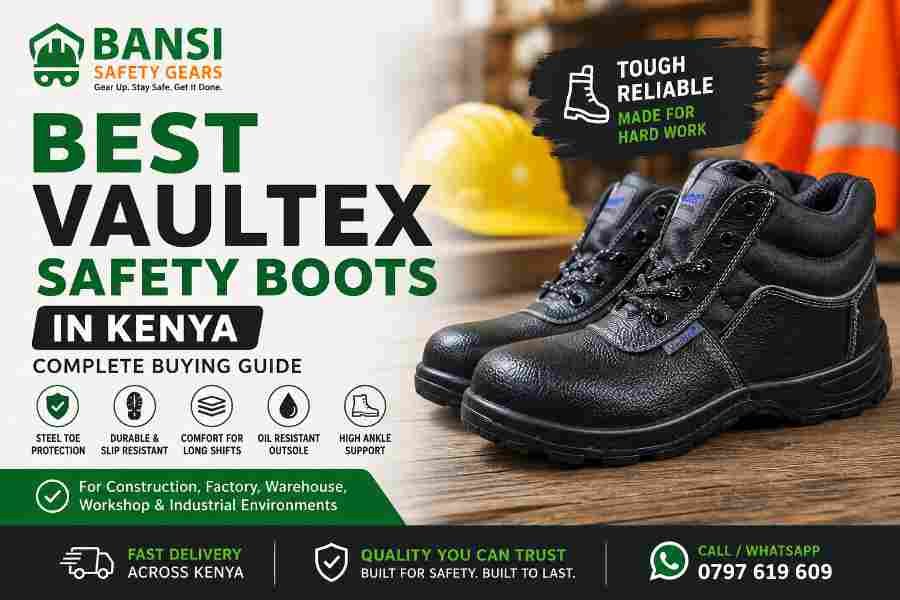
Best Vaultex Safety Boots in Kenya: Complete Buying Guide
Choosing the right Vaultex safety boots in Kenya should begin with the work being performed and the hazards the worker needs protection from.
Construction workers, factory employees, warehouse teams, mechanics, technicians and maintenance personnel can face very different foot hazards. The correct safety boot should therefore match the required protection, workplace surface, working conditions, correct size and documented specification of the exact footwear model.
This guide explains how to compare Vaultex safety boots, understand common footwear features and choose a suitable model for your workplace.
If you are ready to compare available products and current prices, browse our Vaultex Safety Boots in Kenya category.
For detailed technical information on our featured model, view the Vaultex Dual Density Safety Boots.
What Are Vaultex Safety Boots?
Vaultex safety boots are protective workplace footwear intended for professional and industrial environments.
Depending on the exact model, Vaultex footwear may incorporate features such as:
- Protective toe caps
- Penetration-resistant midsoles
- Dual-density soles
- High-ankle construction
- Anti-static properties
- Oil or fuel resistance
- Slip-resistant characteristics
- Other model-specific protective features
Not every Vaultex boot has the same specification.
Always check the documentation for the exact model being purchased rather than applying one set of features to the entire Vaultex brand.
Start With the Workplace Hazard
Do not begin by asking:
Which Vaultex boot looks strongest?
A better question is:
What hazards does the worker actually face?
Consider:
Impact Hazards
Could tools, components, materials or equipment fall or move onto the worker’s feet?
Underfoot Hazards
Could the worker step on nails, sharp metal, construction debris or other penetrating objects?
Floor Conditions
Will the worker operate on:
- Smooth factory floors
- Concrete
- Oily workshop surfaces
- Outdoor ground
- Wet areas
- Uneven terrain
Working Duration
Will the employee spend most of the shift:
- Standing
- Walking
- Driving
- Moving between work areas
- Working outdoors
Workplace Substances
Will the footwear be exposed to:
- Oil
- Fuel
- Water
- Cleaning products
- Chemicals
- Heat
Once the hazards are understood, it becomes much easier to compare suitable Vaultex footwear.
Understanding Steel Toe Protection
Steel toe protection is intended to protect the toe area against specified impact and compression hazards.
The featured Vaultex Dual Density Safety Boot has manufacturer-documented 200 J steel toe protection.
However, steel toe protection describes only one part of the footwear.
A steel toe cap does not automatically mean that a boot also provides:
- Penetration resistance
- Electrical protection
- Waterproofing
- Chemical resistance
- Heat resistance
Each required footwear characteristic should be checked separately.
Understanding Protective Midsoles
Where employees work around nails, sharp metal or similar underfoot hazards, penetration resistance can be important.
A protective midsole is different from a thick outsole.
The featured Vaultex Dual Density model has a manufacturer-documented steel midsole with penetration resistance above 1,100 N.
Where penetration protection is required, verify that it is documented for the exact model being supplied.
What Does Dual Density Mean?
Dual density refers to the sole construction of the footwear.
The featured Vaultex model uses a dual-density PU/PU outsole.
This should not be confused with steel toe protection.
A single boot can be:
Steel toe
and
Dual density
at the same time.
Steel toe describes the toe-protection system.
Dual density describes the sole construction.
This distinction is useful when comparing Vaultex products because different search terms do not necessarily represent different physical boots.
Steel Toe vs Dual Density Safety Boots
These are not competing footwear types.
Steel Toe
Refers to the protective toe cap.
Dual Density
Refers to how the outsole is constructed.
A footwear model may incorporate both features.
The Vaultex Dual Density Safety Boot is an example of a model combining a 200 J steel toe with a dual-density PU/PU outsole.
When comparing footwear, review the complete specification instead of selecting a boot based on one keyword.
High-Ankle vs Low-Cut Safety Footwear
Safety footwear is available in different heights.
High-Ankle Safety Boots
Higher-cut boots provide more coverage around the ankle area.
They may be preferred for selected:
- Construction activities
- Workshops
- Outdoor work
- Maintenance
- Engineering
- Industrial operations
Low-Cut Safety Shoes
Lower-cut footwear can provide a more shoe-like profile and may suit selected:
- Warehouse roles
- Factories
- Technical teams
- Logistics
- Supervisory work
Neither style is automatically safer.
The correct option depends on:
- Workplace hazards
- Worker duties
- Required protection
- Fit
- Workplace conditions
- Employer requirements
For lower-cut options, browse our Safety Shoes in Kenya page.
Oil & Fuel Resistance
The manufacturer documentation for the featured Vaultex Dual Density model states resistance to oil and fuel.
This can be relevant for suitable:
- Garages
- Mechanical workshops
- Engineering departments
- Maintenance teams
- Manufacturing plants
- Industrial facilities
However, oil and fuel resistance should not be interpreted as universal chemical resistance.
Where workers are exposed to a particular substance, check the footwear against the exact chemical and working conditions.
Slip Resistance
Slip resistance is also stated within the technical information for the featured Vaultex Dual Density model.
Slip-resistant properties may be relevant where workers operate on smooth, oily or otherwise challenging surfaces.
However, footwear alone cannot eliminate slip risk.
Other factors include:
- Floor condition
- Water
- Oil
- Dust
- Other contaminants
- Housekeeping
- Worker movement
Always consider footwear together with wider workplace controls.
Chemical Resistance
The technical information for the featured Vaultex model states resistance to acids and alkalis.
This does not mean the footwear is universally chemical-proof.
Chemical suitability can depend on:
- Exact substance
- Concentration
- Exposure duration
- Contact conditions
- Workplace procedure
Where significant chemical exposure exists, confirm compatibility with the specific chemical requirement.
Vaultex Safety Footwear Standards
The manufacturer documentation for the featured Vaultex Dual Density model states EN ISO 20345:2011.
It also lists:
- ASTM F2413-18
- AS/NZS 2210.3
- SS105
These standards belong to the documented model.
Do not automatically apply them to every Vaultex footwear product.
Where an employer, contractor, tender or project specifies a particular standard or classification, compare that requirement against the documentation for the exact model being supplied.
How to Choose Vaultex Safety Boots
Use the following process before ordering.
1. Identify the Work
Understand what the worker actually does during a normal shift.
Do not rely only on the employee’s job title.
2. Identify the Hazards
Consider:
- Falling materials
- Compression hazards
- Sharp objects
- Floor conditions
- Oils
- Water
- Chemicals
- Heat
- Other workplace exposures
3. Determine Required Toe Protection
Where impact or compression hazards exist, establish what toe protection is required.
4. Determine Whether Penetration Protection Is Needed
Where nails or sharp objects are present, check whether the footwear requires a protective midsole.
5. Consider the Workplace Surface
Compare the outsole specification with the actual floor or ground conditions.
6. Consider Workplace Substances
Check whether the worker is exposed to oil, fuel, water, chemicals or other substances.
7. Choose the Appropriate Boot Height
Decide whether a high-ankle safety boot or lower-cut safety shoe is more appropriate.
8. Check Required Standards
Where the employer, contractor or project specifies a footwear standard, verify it against the exact model.
9. Confirm the Correct Size
Correct fit is important for workers who wear safety footwear throughout long shifts.
10. Compare Suitable Models and Prices
Only compare prices after identifying footwear that meets the workplace requirement.
A useful sequence is:
Job → Hazard → Required Protection → Specification → Fit → Price
Choosing Vaultex Boots by Workplace
Different workplaces place different demands on footwear.
| Workplace | Important footwear considerations |
|---|---|
| Construction | Toe protection, penetration protection, outsole, fit |
| Manufacturing | Toe protection, floor conditions, standing duration |
| Warehousing | Fit, walking comfort, toe protection, floor surface |
| Workshops | Toe protection, protective midsole, oil/fuel exposure |
| Maintenance | Walking, workplace surface, required protection |
| Engineering | Project requirements, hazards, fit, documented standards |
These are general considerations.
The correct boot still depends on the worker’s actual job and identified hazards.
Vaultex Boots for Construction
Construction sites can involve:
- Falling materials
- Sharp debris
- Tools
- Machinery
- Rough terrain
- Outdoor conditions
When comparing Vaultex footwear for construction, consider:
- Required toe protection
- Penetration hazards
- Working surface
- Boot height
- Fit
- Project specifications
The featured Vaultex Dual Density model may be considered where its documented steel toe, protective midsole and outsole construction match the site’s requirements.
For other footwear options, browse our main Safety Boots in Kenya category.
Vaultex Boots for Manufacturing
Factory employees may work around:
- Machinery
- Components
- Materials
- Production equipment
- Hard industrial floors
- Oils
- Material-handling operations
Different departments may require different footwear.
For example, a production worker who spends long periods standing may have different footwear considerations from a maintenance technician working around sharp objects and oils.
Choose according to the actual role rather than issuing one boot model across every department automatically.
Vaultex Boots for Warehouses
Warehouse employees may spend much of the day:
- Walking
- Standing
- Picking
- Packing
- Receiving goods
- Loading
- Dispatching stock
They may also work around pallets, forklifts and material-handling equipment.
Important considerations include:
- Toe protection
- Correct fit
- Walking duration
- Floor conditions
- Sole construction
- Penetration hazards
- Required workplace specification
Vaultex Boots for Mechanics & Workshops
Mechanics and workshop employees may work around:
- Tools
- Vehicle components
- Machinery
- Oils
- Fuel
- Metal parts
- Hard floors
Where these hazards exist, check:
- Toe protection
- Protective midsole
- Oil/fuel resistance
- Outsole characteristics
- Correct sizing
The featured Vaultex Dual Density model has documented steel toe protection, a steel protective midsole and manufacturer-stated oil/fuel resistance.
Choosing Vaultex Boots for Long Standing or Walking
Workers who spend long periods on their feet should consider more than the protective specification.
Also check:
- Correct size
- Toe room
- Heel fit
- Sole construction
- Insole
- Boot weight
- Workplace surface
- Amount of daily walking
- Amount of daily standing
The featured Vaultex Dual Density model includes an EVA insole, dual-density outsole and manufacturer-documented heel energy absorption.
These features should still be considered together with correct fit and the worker’s actual duties.
How to Choose the Correct Vaultex Boot Size
Correct sizing is important for everyday workplace use.
Before ordering:
- Confirm your normal work-footwear size
- Wear the type of socks normally used at work
- Check that the toes have suitable room
- Check for excessive heel movement
- Lace the boot securely
- Check the ankle fit
- Walk in the footwear where possible
Do not automatically choose a larger size simply to create additional room.
Company Orders
Companies purchasing footwear for several employees should prepare a size schedule.
For example:
- Size 39 – required quantity
- Size 40 – required quantity
- Size 41 – required quantity
- Size 42 – required quantity
- Size 43 – required quantity
- Size 44 – required quantity
For workforce requirements, visit our Bulk Safety Boots Supplier in Kenya page.
How to Compare Vaultex Models
When comparing Vaultex safety boots, use a consistent checklist.
Compare:
- Product model
- Toe protection
- Midsole protection
- Outsole construction
- Upper material
- Boot height
- Anti-static properties
- Oil/fuel resistance
- Other documented resistance properties
- Safety standards
- Available sizes
- Current price
Avoid comparing only marketing names.
Two pages using different phrases such as “steel toe,” “dual density” or “oil resistant” may sometimes refer to different features of the same physical boot.
Use the actual product model and technical specification as the primary reference.
When Should Vaultex Safety Boots Be Replaced?
Safety footwear should be inspected regularly.
Consider replacement where there is:
- Significant outsole wear
- Loss of tread
- Sole separation
- Deep upper damage
- Damage around the protective toe
- Exposed protective components
- Serious cracking
- Broken laces, eyelets or fastening systems
- Chemical damage
- Heat damage
- Any deterioration that may affect protection
There is no single replacement interval that applies to every worker.
Replacement depends on condition, exposure, frequency of use and manufacturer or workplace guidance.
Vaultex Safety Boots Price in Kenya
The price of Vaultex safety boots depends on the exact product, specification, size and current availability.
When comparing prices, compare like for like.
Consider:
- Toe protection
- Midsole protection
- Sole construction
- Upper material
- Documented resistance properties
- Safety standards
- Size availability
- Exact model
For current Vaultex models and prices, browse our Vaultex Safety Boots in Kenya category.
For wider footwear price comparisons, read our Safety Boots Price in Kenya 2026 guide.
Featured Vaultex Dual Density Safety Boots
One documented model available through Bansi Safety Gear is the Vaultex Dual Density Safety Boot.
Its manufacturer technical information includes:
- 200 J steel toe protection
- Penetration-resistant steel midsole
- Penetration resistance above 1,100 N
- Dual-density PU/PU outsole
- Buffalo leather upper
- EVA insole
- Heel energy absorption
- Anti-static properties
- Manufacturer-stated oil/fuel resistance
For the full specification, current price and ordering information, view the Vaultex Dual Density Safety Boots product page.
Where to Buy Vaultex Safety Boots in Kenya
Bansi Safety Gear supplies Vaultex safety footwear for individual workers, companies and project requirements.
If you want to compare available Vaultex footwear, browse our Vaultex Safety Boots in Kenya category.
If you are interested in the documented Dual Density model, view the Vaultex Dual Density Safety Boots product page.
For other brands and footwear styles, browse our complete Safety Boots in Kenya collection.
Frequently Asked Questions About Vaultex Safety Boots
How do I choose Vaultex safety boots?
Start with the worker’s job and workplace hazards. Identify the required protection, confirm the correct footwear specification and size, then compare suitable models and prices.
Are Vaultex safety boots steel toe?
Some models have steel toe protection. The featured Vaultex Dual Density model has manufacturer-documented 200 J steel toe protection.
What does dual density mean?
Dual density describes the sole construction. The featured Vaultex model uses a dual-density PU/PU outsole.
Is steel toe the same as dual density?
No. Steel toe refers to toe protection, while dual density refers to sole construction. One footwear model can include both.
Do Vaultex boots have protective midsoles?
This depends on the model. The featured Vaultex Dual Density boot has a documented penetration-resistant steel midsole.
Are Vaultex boots oil resistant?
The manufacturer documentation for the featured Dual Density model states resistance to oil and fuel.
Are Vaultex safety boots slip resistant?
Slip resistance is stated in the technical information for the featured model. Do not automatically apply this specification to every Vaultex boot.
Are Vaultex boots suitable for construction?
They may be suitable where the exact model’s protection matches the construction site’s hazards and project requirements.
Are Vaultex boots suitable for warehouses?
Suitable models may be used where their protection, fit and design match the worker’s duties and warehouse hazards.
Are Vaultex boots suitable for mechanics?
Selected Vaultex footwear may be relevant for workshop work. The featured Dual Density model has documented steel toe protection, a steel midsole and manufacturer-stated oil/fuel resistance.
Are Vaultex boots waterproof?
Do not assume waterproof performance unless it is specifically documented for the exact model.
Are Vaultex boots chemical resistant?
The featured model has manufacturer-stated resistance to acids and alkalis, but this does not establish universal chemical resistance.
How much do Vaultex safety boots cost in Kenya?
Prices vary by model and current availability. Check the Vaultex Work Boots category or individual product page for current pricing.
Compare Vaultex Safety Boots in Kenya
There is no single Vaultex safety boot that is automatically right for every worker.
Use this sequence:
Job → Hazard → Required Protection → Specification → Fit → Price
When you know the footwear characteristics you need, browse our Vaultex Safety Boots in Kenya category to compare available products.
For detailed specifications of the featured model, view the Vaultex Dual Density Safety Boots.
For other footwear brands and styles, browse our complete Safety Boots in Kenya collection.
Bansi Safety Gear — Gear Up. Stay Safe. Get It Done.



Leave a Reply