
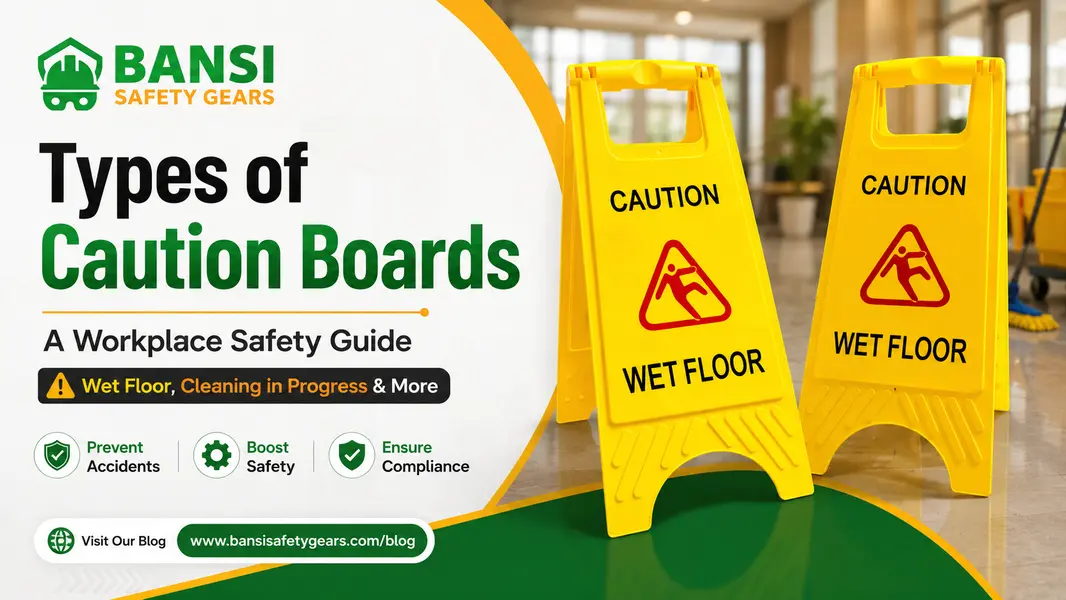
Types of Caution Boards
Caution boards are a simple but important form of temporary workplace communication. They help employees, visitors, customers and other people approaching an area understand that a temporary condition or activity requires additional attention.
You may see caution boards during floor cleaning, housekeeping, maintenance, repairs, servicing or other temporary workplace activities.
However, not every caution board communicates the same thing.
A Wet Floor sign, for example, communicates something different from a Work in Progress sign. Likewise, a Cleaning in Progress sign focuses on an activity rather than specifically describing the condition of the floor.
Understanding the different types of caution boards can help workplaces choose a warning message that accurately represents the situation.
You can explore the complete range of Caution Boards in Kenya available through Bansi Safety Gear.
What Is a Caution Board?
A caution board is a temporary warning sign positioned near an area where people may need to pay additional attention.
Many portable caution boards use a folding A-frame design that allows them to stand independently without permanent installation.
They can therefore be:
- Positioned when required
- Moved as an activity changes location
- Folded after use
- Stored until they are required again
- Reused for suitable recurring workplace activities
The wording and symbol displayed on the board should correspond with the condition or activity being communicated.
A caution board is primarily a communication tool. It does not physically eliminate the underlying hazard or replace stronger controls where those are required.
1. Wet Floor Caution Board
The Wet Floor Caution Board is one of the most recognizable workplace caution signs.
Its purpose is specific: it communicates that a floor or walking surface is currently wet.
Typical situations may include:
- Floor mopping
- Washroom cleaning
- Corridor cleaning
- Lobby cleaning
- Spill cleanup
- Routine housekeeping
- Floor washing
- Facility cleaning
A Wet Floor warning should ideally be positioned where people approaching the affected area have an opportunity to see it before reaching the wet surface.
If a floor is wet, the sign should not replace appropriate action to address the condition.
For detailed product and application information, see our Wet Floor Caution Board Kenya guide.
2. Work in Progress Caution Board
A Work in Progress Caution Board communicates that temporary work is currently underway.
Unlike a Wet Floor sign, it does not specifically indicate a wet walking surface.
It can be relevant to suitable:
- Maintenance work
- Facility repairs
- Equipment servicing
- Building maintenance
- Inspection work
- Temporary repair areas
- General facility work
For example, if a maintenance team is repairing something in a corridor, the main message people need to understand may be that work is underway rather than that the floor is wet.
Learn more through our Work in Progress Caution Board Kenya page.
Can a Work in Progress sign replace a barrier?
Not necessarily.
Some maintenance and repair activities may require restricted access, isolation, barriers, guarding or other controls.
A Work in Progress sign communicates information. It does not automatically provide physical protection or prevent entry into a hazardous area.
3. Cleaning in Progress Caution Board
A Cleaning in Progress Caution Board communicates that cleaning or housekeeping activity is currently underway.
This type of sign can be useful for:
- Office cleaners
- Hotel housekeeping departments
- Cleaning contractors
- Janitorial teams
- Facility-management departments
- Institutional cleaning teams
- Commercial cleaners
Typical environments can include offices, hotels, schools, healthcare facilities, commercial buildings and other managed workplaces.
The key difference is that Cleaning in Progress describes the activity.
It does not automatically mean the floor is wet.
If the cleaning activity creates a wet walking surface, a Wet Floor warning may communicate that specific condition more clearly.
See our Cleaning in Progress Caution Board Kenya page for more information.
4. Folding Caution Boards
Many Wet Floor, Cleaning in Progress and Work in Progress signs share the same general physical format: a folding A-frame caution board.
The folding design offers several practical advantages.
Portable
The board can be moved between different areas as cleaning or maintenance teams change location.
Freestanding
It does not normally require permanent installation on a wall or floor.
Easy to store
Once the warning is no longer required, the board can be folded for storage.
Suitable for temporary conditions
Unlike permanently installed signs, folding caution boards are particularly useful where the warning is only relevant for a limited period.
Examples include temporary cleaning, wet surfaces and maintenance activities.
Wet Floor vs Cleaning in Progress: What Is the Difference?
These two signs are closely related, which can sometimes cause confusion.
Wet Floor
The message describes a condition:
The floor or walking surface is wet.
Cleaning in Progress
The message describes an activity:
Cleaning work is underway.
Suppose a cleaner is dusting or carrying out general housekeeping without creating a wet floor.
A Cleaning in Progress sign could communicate the activity.
If the cleaner is mopping and the walking surface is wet, a Wet Floor warning communicates the specific floor condition.
In some situations, workplace procedures may determine which warning signage should be used.
Wet Floor vs Work in Progress
The difference is even clearer.
A Wet Floor sign warns about a wet walking surface.
A Work in Progress sign communicates that maintenance, repairs, servicing or other temporary work is being carried out.
If someone is repairing equipment, the floor does not have to be wet for a Work in Progress warning to be relevant.
If the primary issue is simply a freshly mopped floor, a Wet Floor sign is usually the more specific message.
Explore both:
Work in Progress Caution Board Kenya
Cleaning in Progress vs Work in Progress
The distinction comes down to the type of activity being communicated.
Cleaning in Progress is specifically about cleaning or housekeeping.
Work in Progress is broader and can relate to maintenance, repairs, servicing and other temporary work.
Choosing the most accurate message can make the warning easier for people approaching the area to understand.
Where Are Caution Boards Commonly Used?
Caution boards can be useful across a wide range of managed facilities.
Hotels
Housekeeping teams may use Wet Floor or Cleaning in Progress boards during suitable cleaning activities.
Maintenance departments may instead use Work in Progress signs where repair or servicing work is underway.
Offices
Office cleaners and facility teams may use temporary caution boards during floor cleaning, housekeeping and maintenance activities.
Hospitals and Healthcare Facilities
Facility-cleaning and maintenance teams may use appropriate temporary warning signage according to the site’s procedures and the activity being carried out.
Schools and Universities
Temporary warning boards may support suitable cleaning, housekeeping and maintenance activities within managed educational facilities.
Shopping and Commercial Facilities
Public-facing buildings often require clear temporary communication while cleaners or facility teams carry out suitable work.
Warehouses
Caution boards may support temporary communication during cleaning or maintenance.
However, signs should not be treated as substitutes for traffic segregation, barriers, isolation or other controls required for the actual warehouse activity.
Cleaning Companies
Portable caution boards are particularly useful for contract cleaners because teams may move between different rooms, floors, buildings and client premises.
How Do You Choose the Right Caution Board?
Start with one question:
What exactly needs to be communicated?
If the floor is wet
Consider a Wet Floor Caution Board.
If cleaning is underway
Consider a Cleaning in Progress Caution Board.
If maintenance or repairs are underway
Consider a Work in Progress Caution Board.
The warning should accurately describe the condition or activity people approaching the area need to understand.
You should also consider:
- Visibility of the warning
- Direction of pedestrian movement
- Number of entrances
- Size of the affected area
- Number of areas requiring signs
- How frequently signs need to move
- Storage arrangements
- Whether additional controls are required
Where Should Caution Boards Be Positioned?
A warning sign is most useful when people can see it before they reach the condition or activity being communicated.
When positioning a caution board, consider:
Entrances
Can people enter the area through more than one door or access point?
Corridors
Can pedestrians approach from opposite directions?
Visibility
Could furniture, machinery, shelves or other objects block the warning?
Area size
A large or irregularly shaped affected area may require different placement considerations from a small area.
Changing work areas
If a cleaning or maintenance team moves, the warning may also need to move.
Walkway obstruction
The sign itself should be positioned thoughtfully so that it does not unnecessarily create another obstruction.
Is One Caution Board Always Enough?
Not necessarily.
There is no useful universal rule that one board will be sufficient for every location.
The appropriate setup depends on factors such as:
- Size of the affected area
- Number of entrances
- Walking routes
- Visibility
- Building layout
- Nature of the activity
For example, a small room with one entrance is different from a long corridor accessible from several directions.
The objective is for people approaching the relevant area to have a reasonable opportunity to see the warning.
When Should a Temporary Caution Sign Be Removed?
A temporary sign should continue to reflect the actual situation.
Once the condition or activity has ended, the warning should be removed or updated as appropriate.
Leaving warning boards permanently in place when the warning no longer applies can make temporary hazard communication less meaningful.
Common Caution Board Mistakes
Using the wrong sign
A generic warning may be less useful than one that accurately describes the condition.
Poor positioning
A sign that cannot be seen until someone has already entered the area provides limited advance warning.
Ignoring multiple approaches
People may enter from several directions.
Leaving signs in place unnecessarily
Temporary signs should correspond with temporary conditions.
Using signage instead of addressing the problem
A Wet Floor sign does not replace dealing with the wet floor.
Using a warning sign instead of stronger controls
Some situations require barriers, restricted access, isolation or other measures.
Are Caution Boards a Complete Safety Control?
No.
Caution boards provide warning and communication.
They do not physically eliminate hazards.
For example:
A Wet Floor sign does not dry the floor.
A Work in Progress sign does not isolate machinery.
A Cleaning in Progress sign does not control chemical exposure.
Appropriate workplace controls should therefore be determined by the actual task, condition and hazards involved.
Explore Caution Boards in Kenya
Bansi Safety Gear offers portable workplace warning boards for suitable cleaning, housekeeping, wet-floor and temporary work applications.
Start with our main Caution Boards in Kenya collection.
You can also explore the dedicated guides:
Wet Floor Caution Board Kenya – for temporary wet walking surfaces.
Work in Progress Caution Board Kenya – for suitable maintenance, repairs and temporary work.
Cleaning in Progress Caution Board Kenya – for cleaning and housekeeping activities.
Choosing the right caution board begins with understanding the condition you need to communicate.
Gear Up. Stay Safe. Get It Done.



Leave a Reply