N95 vs KN95 Masks Kenya
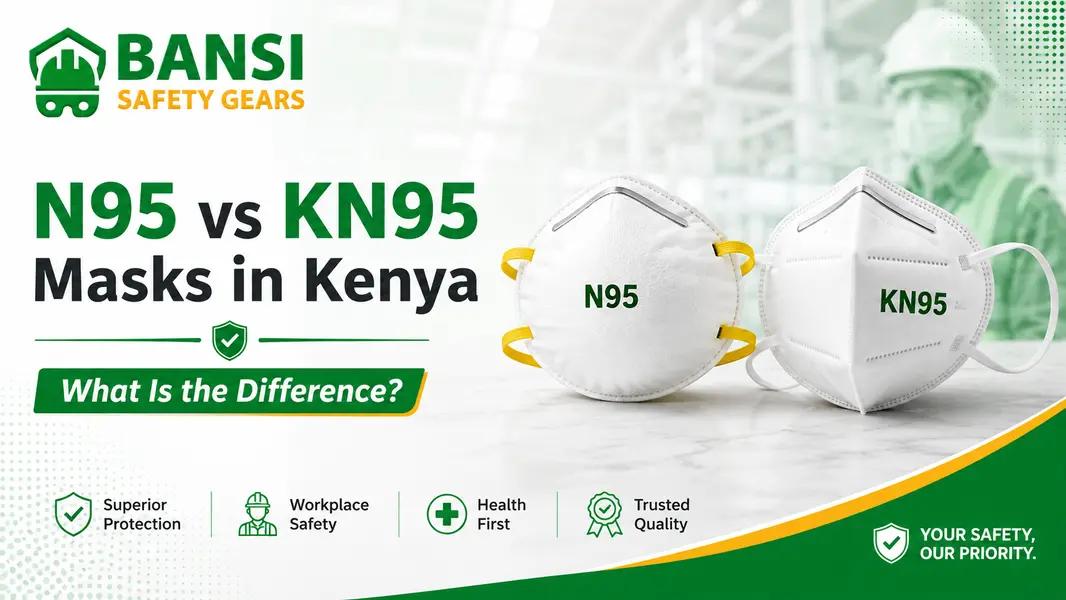
If you are comparing N95 vs KN95 masks in Kenya, the two respirators can look very similar, but they should not automatically be treated as identical products.
Both are close-fitting filtering facepiece respirators intended for suitable airborne particulate hazards. However, they belong to different standards and approval systems.
For an individual buyer, the question may be:
Should I buy an N95 or a KN95 mask?
For a safety officer or procurement team, the better question is:
Which respirator meets the specification required for the actual workplace hazard?
This guide explains the differences between N95 and KN95 respirators, their applications, limitations, fit requirements and what Kenyan buyers should check before purchasing.
Ready to shop? Browse KN95 Masks in Kenya.
N95 vs KN95 Masks: Quick Comparison
| Feature | N95 Respirator | KN95 Respirator |
|---|---|---|
| Product type | Filtering facepiece respirator | Filtering facepiece respirator |
| Main application | Suitable airborne particles | Suitable airborne particles |
| Filtration designation | At least 95% under applicable NIOSH testing | KN95 filtration requirement under applicable standard |
| Approval / standard system | U.S. NIOSH approval system | Commonly associated with China’s GB 2626 requirements |
| Fit | Close-fitting | Close-fitting |
| Disposable | Generally yes | Generally yes |
| Gas / vapour protection | No | No |
| Fit important | Yes | Yes |
| Product verification important | Yes | Yes |
The biggest mistake is selecting respiratory PPE based only on the words N95 or KN95.
The exact:
- Manufacturer
- Model
- Product markings
- Standard
- Documentation
- Fit
- Intended application
should also be considered.
What Is an N95 Respirator?
An N95 respirator is a filtering facepiece respirator approved under the U.S. National Institute for Occupational Safety and Health, commonly called NIOSH.
The 95 refers to the respirator’s minimum filtration classification under the applicable NIOSH test requirements.
An authentic NIOSH-approved N95 should carry identifying information relating to the approved product.
This can include:
- Manufacturer or approval holder
- Model or part number
- N95 filter classification
- NIOSH marking
- Approval number
A mask simply printed with the word N95 should not automatically be assumed to be NIOSH approved.
If your tender, company specification or safety programme specifically requests a NIOSH-approved N95, verify the exact model being offered.
What Is a KN95 Mask?
A KN95 respirator is also a filtering facepiece designed for suitable airborne particulate protection.
However, KN95 is not a NIOSH approval category.
KN95 products are commonly associated with China’s GB 2626 respirator requirements.
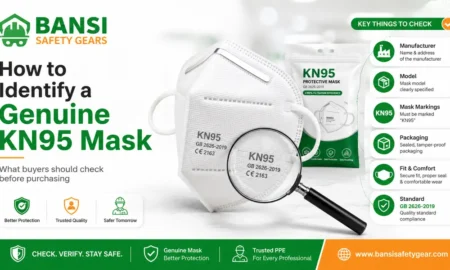
When buying a KN95, check:
- Manufacturer
- Exact model
- KN95 marking
- Standard stated on the product or packaging
- Packaging information
- Available manufacturer documentation
- Product condition
- Intended application
- Fit
A KN95 should not automatically be advertised as a “NIOSH-approved N95 equivalent” unless the exact product independently carries the relevant approval.
Browse KN95 Masks in Kenya to compare current options.
Do N95 and KN95 Masks Both Filter 95%?
The 95 in the two classifications relates to minimum filtration-performance requirements under their respective testing systems.
That does not mean any two masks with “95” in their names are technically identical.
Standards can differ in areas such as:
- Test methods
- Breathing resistance
- Product markings
- Certification or conformity procedures
- Quality controls
- Design requirements
For workplace procurement, evaluate the exact respirator and its documentation, not simply the number in the product name.
Which Is Better: N95 or KN95?
There is no universal answer.
The correct respirator depends on:
- Workplace hazard
- Required standard
- Employer specification
- Required protection level
- Product authenticity
- Manufacturer
- Model
- Fit
- Documentation
- Procurement requirements
If an RFQ states NIOSH-approved N95, the offered product should satisfy that exact specification.
If it specifies KN95, evaluate the exact KN95 model and applicable documentation.
If alternatives are permitted, the procurement specification should explain what technical requirements an alternative must meet.
N95 vs KN95 for Dust
Both N95 and KN95 products are particulate filtering respirators.
They may be suitable for certain dust and airborne-particle hazards where the workplace risk assessment supports their use.
Possible applications can include suitable tasks in:
- Construction
- Manufacturing
- Warehouses
- Workshops
- Maintenance
- Agriculture
- Cleaning
- Material handling
However, dust is a very broad description.
Construction dust, wood dust, agricultural dust and manufacturing particulates can present different hazards and exposure levels.
Use this process:
Identify Hazard → Assess Exposure → Determine Required Protection → Select Respirator → Confirm Fit
For other options, browse Respiratory Protection Kenya.
Do N95 or KN95 Masks Protect Against Chemical Vapours?
No.
N95 and KN95 filtering facepieces are primarily designed for suitable particulate hazards.
They should not automatically be selected for:
- Solvent vapours
- Organic vapours
- Acid gases
- Chemical gases
- Paint vapours
- Certain pesticide vapours
These hazards may require a reusable half-face or full-face respirator fitted with the appropriate compatible cartridge.
Browse Chemical Respirators Kenya.
N95 vs KN95 Fit
Fit is critical.
A high-quality filtering material cannot provide its intended protection if contaminated air is entering through gaps between the respirator and the wearer’s face.
A filtering facepiece should generally:
- Cover the nose
- Cover the mouth
- Extend beneath the chin
- Sit closely against the cheeks
- Seal around the nose
- Have minimal obvious gaps
Your existing page correctly emphasizes that fit is important for both classifications and that facial hair can interfere with the seal of a tight-fitting respirator.
Can Facial Hair Affect N95 or KN95 Fit?
Yes.
Facial hair crossing the sealing surface can interfere with the respirator’s face seal.
This includes:
- Beards
- Heavy stubble
- Sideburns crossing the seal
Where tight-fitting respirators are required occupationally, appropriate fitting and workplace fit-testing procedures should be followed.
Ear Loops vs Head Straps
Many KN95 products use ear loops, while many occupational N95 respirators use head straps.
However, this is not an absolute identification rule.
Do not decide whether a mask is a genuine N95 or KN95 simply from the strap style.
The important questions are:
- What is the exact product?
- Which standard does it claim?
- Does the documentation support that claim?
- Does it fit the wearer correctly?
How Can You Identify a NIOSH-Approved N95?
For a respirator represented as NIOSH approved, check the product markings.
Important identifying information may include:
- Manufacturer or approval holder
- Model or part number
- Filter classification
- NIOSH marking
- Approval number
For procurement teams, a specification should ideally be more precise than:
“Supply N95 masks.”
Where compliance matters, identify the exact required approval, model or acceptable technical specification.
What Should You Check When Buying a KN95?
Before approving a KN95 for workplace use, check:
- Manufacturer name
- Model
- KN95 marking
- Applicable standard
- Packaging
- Product condition
- Manufacturer documentation
- Intended use
- Fit
- Pack quantity
Do not assume that every product carrying KN95 markings is technically identical.
N95 vs KN95 for Construction Workers
Construction can generate airborne particles during:
- Drilling
- Cutting
- Grinding
- Sanding
- Demolition
- Cement handling
- Sweeping
- Material handling
- Site maintenance
An N95 or KN95 may be suitable for some particulate hazards, but respirator selection should be based on the actual exposure and required protection level.
For complete site PPE, visit Construction PPE Kenya.
N95 vs KN95 for Manufacturing
Manufacturing operations can produce particulate exposure during:
- Production
- Processing
- Powder handling
- Material preparation
- Maintenance
- Packing
- Cleaning
Different departments within the same factory may require different respiratory protection.
A KN95 or N95 should not automatically be issued to every worker without considering the specific hazard.
N95 vs KN95 for Agriculture
Agricultural tasks may generate dust from:
- Grain
- Feed
- Soil
- Harvesting
- Dry plant material
- Cleaning
N95 or KN95 respirators may be considered for appropriate particulate exposure.
They should not automatically be selected for pesticide vapours or chemical spraying.
For spraying PPE, visit Pesticide Spraying PPE Kenya.
N95 vs KN95 vs Surgical Mask
These products should not automatically be treated as interchangeable.
N95
A close-fitting particulate filtering respirator under the NIOSH approval system.
KN95
A close-fitting particulate filtering respirator under the applicable KN95 standard system.
Surgical Face Mask
Generally a looser-fitting medical or barrier mask with a different intended function.
Where workplace respiratory protection is required, use the respirator specified for the actual hazard.
N95 vs KN95 vs General Dust Mask
A basic disposable dust mask may look similar to a respirator but may not carry an N95 or KN95 classification.
Do not assume that:
Dust mask = KN95 = N95
Each product should be evaluated according to its actual markings and documentation.
Are Valved KN95 Masks Different?
Some KN95 respirators include an exhalation valve.
The valve can help:
- Reduce exhalation resistance
- Reduce heat buildup
- Reduce moisture accumulation
- Improve wearer comfort
However, the valve does not automatically improve filtration performance.
A valved respirator should also not automatically be selected where controlling the wearer’s exhaled air is important.
Browse KN95 Masks in Kenya for available designs.
N95 and KN95 Respirators Do Not Supply Oxygen
Neither a normal N95 nor KN95 filtering facepiece supplies oxygen.
Do not rely on them in:
- Oxygen-deficient atmospheres
- Unknown atmospheres
- Immediately dangerous environments
- Unassessed confined spaces
These conditions may require atmospheric testing and specialist respiratory equipment.
When Should N95 or KN95 Masks Be Replaced?
Follow the manufacturer’s instructions for the exact respirator.
A disposable filtering facepiece should generally be removed from service when it becomes:
- Wet
- Dirty
- Damaged
- Contaminated
- Torn
- Misshapen
- Difficult to breathe through
- Unable to maintain an appropriate fit
Avoid applying one universal replacement time to every respirator.
N95 vs KN95 for Procurement Teams
Bulk purchasing requires more than comparing the price per mask.
Procurement teams should consider:
Product Specification
Clearly state whether the requirement is:
- NIOSH-approved N95
- KN95 to a specified standard
- Or an approved technical alternative
Manufacturer & Model
Where a product has already been technically approved, identify the exact manufacturer and model.
Quantity
Specify whether the requirement is in:
- Pieces
- Packs
- Boxes
- Cartons
Documentation
Include any technical documentation needed for internal approval.
Packaging
Specify packaging requirements where relevant.
Delivery
Provide the required delivery location and date.
A useful RFQ format is:
Respirator Type → Standard → Model / Approved Alternative → Quantity → Documentation → Delivery
N95 vs KN95 Mask Price in Kenya
Price is important, but it should not be the first technical selection criterion.
Two respirators may look almost identical while differing in:
- Manufacturer
- Standard
- Model
- Construction
- Packaging
- Fit
- Documentation
- Order quantity
For current KN95 options and prices, browse KN95 Masks in Kenya.
For broader mask and respirator pricing, visit Respirator Mask Price in Kenya.
Which Mask Should a Procurement Officer Specify?
Start with the workplace requirement.
If the specification says:
NIOSH-approved N95
then the supplied respirator should meet that requirement.
If it says:
KN95 to the specified standard
then confirm the exact KN95 product and documentation.
If alternatives are permitted, state that clearly.
Do not allow a supplier to substitute products merely because they look similar.
KN95 Masks Available From Bansi Safety Gear
Bansi Safety Gear supplies KN95 masks for suitable individual and workplace requirements subject to current availability.
Browse KN95 Masks in Kenya to compare current products.
For reusable respirators, filters and cartridges, explore Respiratory Protection Kenya.
For company requirements, Request a PPE Quotation.
Frequently Asked Questions
Is KN95 the same as N95?
No. Both are filtering facepiece respirator classifications, but they belong to different standards and approval systems.
Is N95 better than KN95?
Not automatically for every purchasing situation. The correct respirator depends on the hazard, required specification, product verification and fit.
Does an N95 filter at least 95%?
A NIOSH-approved N95 is classified to provide at least 95% filtration efficiency under the applicable NIOSH testing requirements.
Do KN95 masks filter airborne particles?
KN95 respirators are designed around particulate-filtration requirements under the applicable KN95 standard. Verify the exact product and manufacturer information.
Can KN95 masks be used for construction dust?
They may be suitable for certain particulate hazards depending on the actual contaminant, exposure level and required protection.
Do N95 masks protect against gases?
No. N95 filtering facepieces are intended for suitable particulates, not gases or vapours.
Do KN95 masks protect against chemical vapours?
No KN95 particulate respirator should automatically be used for chemical gases or vapours. A suitable cartridge respirator may be required.
Is fit important with N95 and KN95 respirators?
Yes. Leakage around the face can reduce the protection received by the wearer.
Can facial hair affect respirator fit?
Yes. Facial hair crossing the sealing surface can interfere with the fit of a close-fitting respirator.
How can I identify an approved N95?
Check the required NIOSH markings and verify the exact manufacturer, model and approval information.
Is a KN95 the same as a surgical mask?
No. A KN95 is a close-fitting particulate respirator, while a typical surgical mask has a different fit and purpose.
Can companies buy KN95 masks in bulk in Kenya?
Yes. Companies, contractors and institutions can submit their quantity, specification and delivery requirements for quotation.
Buy KN95 Masks in Kenya
If your workplace requirement allows KN95 respirators, browse KN95 Masks in Kenya to compare currently available products.
For wider respiratory PPE, including reusable half masks, full-face respirators, filters and cartridges, visit Respiratory Protection Kenya.
For company quantities and formal RFQs, Request a PPE Quotation.
Bansi Safety Gear — Gear Up. Stay Safe. Get It Done.

Comment (1)
[…] For a deeper comparison, read N95 vs KN95 Masks in Kenya. […]