KN95 vs Surgical Mask Kenya
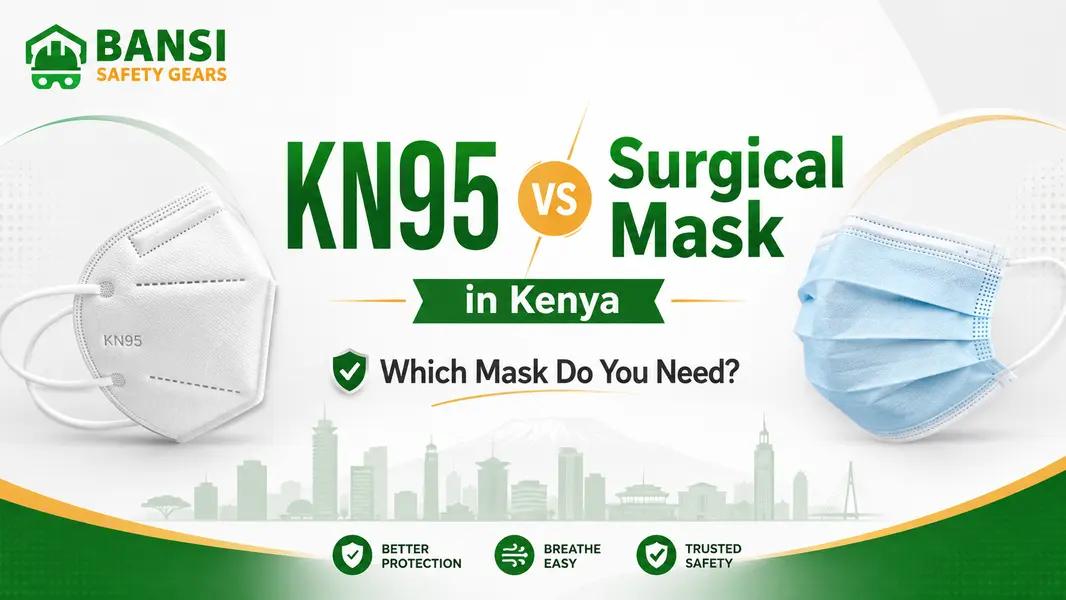
When comparing a KN95 vs surgical mask in Kenya, it is important to understand that these products are designed for different purposes and should not automatically be treated as interchangeable.
A KN95 mask is a close-fitting filtering facepiece respirator intended for suitable airborne particulate hazards when the exact product meets the required specification and fits the wearer correctly.
A surgical mask is generally a disposable medical or barrier mask with a different fit, construction and intended use.
For workplaces, the right choice should depend on:
Hazard → Required Protection → Product Specification → Fit → Intended Application
Not simply which mask appears thicker, stronger or cheaper.
If you are looking for particulate respirators, browse KN95 Masks in Kenya.
KN95 vs Surgical Mask: Quick Comparison
| Feature | KN95 Mask | Surgical Mask |
|---|---|---|
| Product type | Filtering facepiece respirator | Medical / surgical-style face mask |
| Fit | Designed to fit closely | Generally looser fitting |
| Main purpose | Suitable particulate respiratory protection | Barrier / medical use depending on exact specification |
| Face seal important | Yes | Does not create the same respirator-style seal |
| Product standard | KN95 respirator standard | Depends on exact medical-mask specification |
| Disposable | Generally yes | Generally yes |
| Gas protection | No | No |
| Vapour protection | No | No |
| Workplace selection | Hazard-based | Application-based |
| Product verification | Important | Important |
The biggest difference is not simply filtration percentage.
It is the complete combination of:
Standard → Filtration → Fit → Face Seal → Intended Use
What Is a KN95 Mask?
A KN95 mask is a filtering facepiece respirator intended to reduce the wearer’s exposure to suitable airborne particles.
It is designed to fit closely around the:
- Nose
- Cheeks
- Mouth
- Chin
The face seal is an important part of respirator performance.
If significant gaps are present around the edges, air can bypass the filtering material.
For a more detailed explanation, read the KN95 Masks Kenya Guide.
What Is a Surgical Mask?
A surgical mask is generally a disposable face mask designed around medical, procedural or barrier requirements.
Unlike a close-fitting respirator, a typical surgical mask does not create the same tight seal around the wearer’s face.
Air can therefore move around the sides of the mask more easily.
Surgical masks can also differ according to:
- Manufacturer
- Model
- Number of layers
- Construction
- Applicable standard
- Filtration characteristics
- Fluid-resistance specification where applicable
- Packaging
- Intended medical or procedural use
Do not assume that every blue 3-ply mask is automatically a certified surgical mask.
The exact product documentation matters.
KN95 vs 3-Ply Surgical Mask
A three-layer construction by itself does not make a mask equivalent to a respirator.
A 3-ply surgical-style mask may be useful for suitable hygiene, healthcare or barrier applications.
A KN95, by contrast, is intended to function as a close-fitting particulate respirator.
This distinction matters where workers are exposed to airborne particulates.
Is a KN95 Better Than a Surgical Mask?
Not in every situation.
The correct answer depends on what the mask is being used for.
For Suitable Particulate Hazards
A properly selected and fitted particulate respirator such as a KN95 may be more appropriate.
For Certain Medical or Barrier Applications
A surgical mask meeting the required medical specification may be the appropriate product.
The correct question is not:
“Which mask is better?”
It is:
“Which mask is appropriate for this application?”
KN95 vs Surgical Mask for Dust
Where workers are exposed to suitable airborne dust or particles, a close-fitting particulate respirator may be more appropriate than relying on a loose-fitting surgical mask.
Potential particulate-generating tasks include:
- Drilling
- Cutting
- Sanding
- Grinding
- Material handling
- Maintenance
- Workshop operations
- Certain manufacturing processes
- Warehousing
- Dusty agricultural activities
However, the word dust alone is not enough to select respiratory PPE.
Different dusts can present different hazards.
Use:
Identify Hazard → Assess Exposure → Determine Protection Required → Select Respirator → Confirm Fit
For more options, browse Respiratory Protection Kenya.
KN95 vs Surgical Mask for Construction
Construction workers can encounter airborne particles during activities such as:
- Cutting
- Drilling
- Grinding
- Sanding
- Demolition
- Sweeping
- Material handling
- Site maintenance
A surgical mask should not automatically be treated as a replacement for an occupational particulate respirator where respiratory protection is required.
The correct respirator depends on the task and hazard assessment.
Construction workers may also require:
- Safety helmets
- Safety goggles
- Hearing protection
- Gloves
- Safety footwear
- Reflective clothing
- Fall protection
For complete site PPE, visit Construction PPE Kenya.
KN95 vs Surgical Mask for Manufacturing
Manufacturing environments can contain very different airborne hazards.
Examples can include:
- Powders
- Dust
- Fine particulates
- Grinding particles
- Process particles
- Maintenance debris
- Material-handling dust
Where particulate respiratory protection is required, a KN95 may be one possible option.
However, other factory exposures may require a different type of respirator.
Do not issue the same mask across every department without considering the actual hazard.
KN95 vs Surgical Mask for Healthcare
Healthcare requirements should be based on the exact procedure, infection-control policy and required product specification.
A surgical mask and a KN95 respirator should not automatically be substituted for one another simply because both cover the nose and mouth.
Where a medical facility specifies:
- A surgical mask
- A particular medical-mask standard
- A particulate respirator
- A specific respirator approval
procurement should follow that exact requirement.
This is especially important in tenders and institutional purchasing.
KN95 vs Surgical Mask for Food Processing
Food-processing businesses may use disposable masks as part of workplace hygiene and food-safety procedures.
However, a food-handling mask requirement and a respiratory-protection requirement are not necessarily the same thing.
If the goal is workplace hygiene, follow the facility’s hygiene specification.
If workers are exposed to hazardous airborne particles, perform a respiratory hazard assessment and select PPE accordingly.
Do KN95 Masks Protect Against Chemical Vapours?
No KN95 filtering facepiece should automatically be selected for gases or chemical vapours.
KN95 respirators are intended for suitable particulate hazards.
They should not automatically be used for:
- Solvent vapours
- Organic vapours
- Acid gases
- Chemical gases
- Certain paint vapours
- Certain pesticide vapours
These hazards may require a reusable respirator with the correct compatible filter or cartridge.
Browse Chemical Respirators Kenya.
Do Surgical Masks Protect Against Chemical Vapours?
A normal surgical mask should also not be treated as protection against chemical gases or vapours.
If the hazard involves chemicals, start with:
- Chemical identity
- Safety Data Sheet
- Exposure assessment
- Required respiratory protection
- Correct filter or cartridge where applicable
Do not choose respiratory PPE simply because a mask covers the nose and mouth.
Why Face Seal Matters
This is one of the most important differences between KN95 and surgical masks.
A KN95 is intended to sit closely around the face.
Check around the:
- Nose
- Cheeks
- Chin
- Sides of the face
Large gaps can reduce the protection received by the wearer.
A typical surgical mask does not create the same respirator-style facial seal.
Can Facial Hair Affect KN95 Fit?
Yes.
Facial hair crossing the sealing area can interfere with the fit of a close-fitting respirator.
This can include:
- Beards
- Heavy stubble
- Sideburns crossing the seal
Where workplace respiratory protection requires a tight-fitting respirator, appropriate fitting and fit-testing procedures should be followed.
Ear Loops Do Not Determine Protection
Many surgical masks use ear loops.
Many KN95 masks also use ear loops.
Therefore:
Ear loops alone do not tell you what level of protection a mask provides.
Check:
- Manufacturer
- Exact model
- Product type
- Product standard
- Markings
- Intended application
- Fit
- Documentation
Two masks that look almost identical may have very different specifications.
Is a KN95 the Same as an N95?
No.
KN95 and N95 are filtering facepiece respirator classifications associated with different standards or approval systems.
Do not automatically describe a KN95 as a NIOSH-approved N95 equivalent unless the exact product independently carries the relevant approval.
For the full comparison, read N95 vs KN95 Masks in Kenya.
Surgical Mask vs N95 vs KN95
The three terms should not be used interchangeably.
KN95
Close-fitting particulate filtering respirator under the applicable KN95 standard.
N95
Filtering facepiece respirator under the U.S. NIOSH approval system.
Surgical Mask
Medical/barrier mask with different fit and product requirements.
Procurement teams should order the product specified for the actual application.
Can KN95 or Surgical Masks Be Used for Pesticide Spraying?
Neither product should automatically be selected for pesticide spraying.
Pesticide applications can involve:
- Droplets
- Mists
- Aerosols
- Vapours
- Combinations of contaminants
Respiratory PPE should be selected using the pesticide label, Safety Data Sheet and exposure assessment.
For agricultural chemical PPE, visit Pesticide Spraying PPE Kenya.
KN95 Masks Do Not Supply Oxygen
A KN95 is an air-purifying filtering facepiece.
It does not provide breathing oxygen.
Do not rely on KN95 or ordinary surgical masks in:
- Oxygen-deficient atmospheres
- Unknown atmospheres
- Immediately dangerous environments
- Unassessed confined spaces
These situations may require specialist respiratory equipment and atmospheric testing.
Which Mask Should a Workplace Buy?
Start with the workplace hazard or application.
Ask:
- What contaminant or exposure is present?
- Is the requirement medical, hygiene or occupational respiratory protection?
- Is the airborne hazard particulate, gas or vapour?
- What protection level is required?
- Which product standard is specified?
- Does the respirator fit correctly?
- Is the product compatible with other PPE?
- What documentation is required?
Do not begin with:
“Which mask is cheapest?”
Begin with:
“Which product does this task require?”
KN95 vs Surgical Mask for Procurement Teams
Avoid RFQ descriptions such as:
“Supply masks.”
That description can result in completely different products being quoted.
A stronger specification is:
Product Type → Standard → Manufacturer / Approved Alternative → Quantity → Packaging → Documentation → Delivery
Example KN95 Requirement
KN95 respirator – specified standard – required quantity – packaging specification – product documentation required
Example Surgical Mask Requirement
Surgical face mask – required medical-mask specification – required quantity – packaging requirement
The more precise the specification, the easier it becomes to compare supplier quotations correctly.
What Procurement Teams Should Check
For KN95 Respirators
Check:
- Manufacturer
- Model
- KN95 markings
- Applicable standard
- Packaging
- Product documentation
- Fit requirements
- Quantity
For Surgical Masks
Check:
- Manufacturer
- Model
- Intended medical use
- Exact standard where required
- Mask classification where applicable
- Packaging
- Documentation
- Quantity
Do not apply certification from one product model to another.
KN95 vs Surgical Mask Price in Kenya
Price varies according to:
- Manufacturer
- Model
- Product type
- Technical specification
- Packaging
- Quantity
- Documentation requirements
- Availability
- Delivery destination
A surgical mask may have a lower unit price than a particulate respirator, but that does not make it an appropriate substitute where respiratory protection is required.
For current KN95 options and prices, browse KN95 Masks Price in Kenya.
Buying KN95 Masks in Bulk
Companies, contractors and institutions can purchase KN95 masks for larger workplace requirements.
Include:
- Required quantity
- Product specification
- Preferred manufacturer or model
- Required standard
- Valved or non-valved requirement where relevant
- Packaging
- Product documentation
- Delivery location
- Required date
Visit Bulk KN95 Masks for Companies in Kenya for corporate requirements.
Frequently Asked Questions
What is the main difference between a KN95 and a surgical mask?
A KN95 is a close-fitting filtering facepiece respirator intended for suitable particulate hazards. A typical surgical mask has a different fit, specification and intended purpose.
Is KN95 better than a surgical mask?
Not universally. The correct product depends on the hazard or application.
Is KN95 better for dust?
For suitable particulate hazards, a correctly selected and fitted particulate respirator may be more appropriate than a loose-fitting surgical mask.
Can surgical masks be used for construction dust?
They should not automatically be treated as occupational respiratory protection. Select respiratory PPE according to the actual hazard.
Does a KN95 fit tighter than a surgical mask?
KN95 respirators are intended to fit closely around the face. Typical surgical masks generally have a looser fit.
Can a surgical mask replace a KN95?
Not automatically. If respiratory protection is required, use the respirator specified for the hazard.
Can a KN95 replace a surgical mask?
Not automatically. Medical environments may require a particular mask specification for the procedure or infection-control programme.
Do KN95 masks protect against gases?
No. KN95 particulate filtering respirators are not intended for chemical gases or vapours.
Do surgical masks protect against chemical vapours?
No normal surgical mask should be relied upon for chemical gas or vapour protection.
Can facial hair affect KN95 fit?
Yes. Facial hair crossing the sealing surface can interfere with the fit of a close-fitting respirator.
Is KN95 the same as N95?
No. KN95 and NIOSH-approved N95 respirators belong to different standards or approval systems.
Are all surgical masks the same?
No. Manufacturer, standard, classification, construction, documentation and intended use can differ.
Are all KN95 masks the same?
No. Manufacturer, model, standard, design, fit and documentation can vary.
Which should procurement officers specify?
Specify the exact product required rather than simply writing “mask.” Include the type, applicable standard, quantity, packaging and required documentation.
Can companies buy KN95 masks in bulk?
Yes. Larger requirements can be submitted for formal quotation.
Buy the Right Mask for Your Application
If you require a particulate respirator, browse KN95 Masks in Kenya.
For KN95 selection guidance, read the KN95 Masks Kenya Guide.
For standards comparison, read N95 vs KN95 Masks in Kenya.
For other respirator types, browse Respiratory Protection Kenya.
For company quantities, visit Bulk KN95 Masks Kenya or Request a PPE Quotation.
Bansi Safety Gear — Gear Up. Stay Safe. Get It Done.

Leave a Reply