
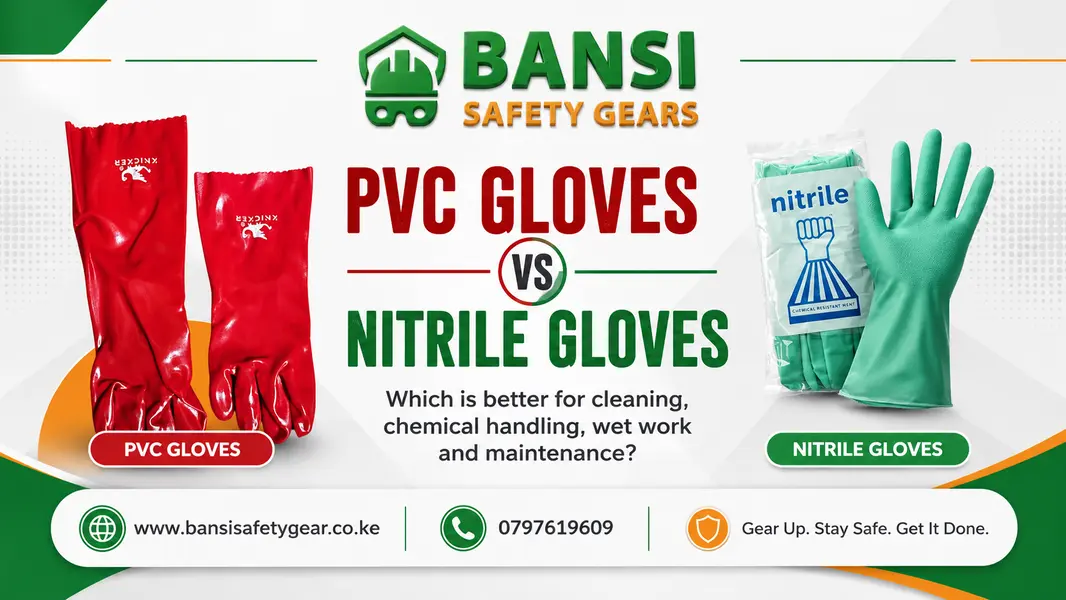
PVC Gloves vs Rubber Gloves
PVC gloves and rubber gloves are both commonly used for cleaning, wet work and general hand protection, but they have different material properties and applications. The better option depends on the task, chemical exposure, required flexibility, glove length, durability and whether the glove is intended for repeated use.
PVC gloves are made from polyvinyl chloride, while the term “rubber gloves” often refers to gloves made from natural rubber latex or other rubber-based materials.
For a complete overview of PVC glove types and applications, visit our PVC Gloves in Kenya guide.
What Are PVC Gloves?
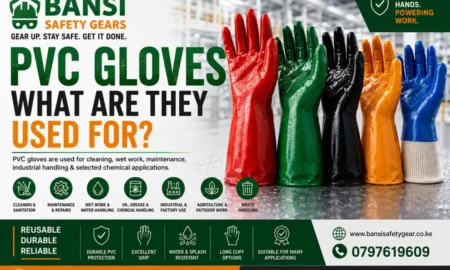
PVC gloves are protective gloves made from or coated with polyvinyl chloride.
They are available in different forms, including:
- Long PVC gloves
- Red PVC gloves
- PVC gauntlet gloves
- Heavy-duty PVC gloves
- PVC coated gloves
- Reusable PVC gloves
- Chemical-resistant PVC gloves for selected substances
PVC gloves are commonly considered for cleaning, wet work, maintenance, industrial handling and selected chemical applications.
Explore our PVC Gloves in Kenya guide for more information.
What Are Rubber Gloves?
Rubber gloves are protective gloves manufactured from rubber-based materials.
In everyday use, the term often refers to natural rubber or latex cleaning gloves, although other synthetic rubber materials are also used in protective gloves.
Depending on their construction, rubber gloves may be used for:
- Household cleaning
- Commercial cleaning
- Washing
- Wet work
- General housekeeping
- Selected industrial tasks
- Selected chemical applications where compatible
The exact material and specification should always be checked.
PVC Gloves vs Rubber Gloves: Main Differences
| Feature | PVC Gloves | Rubber Gloves |
|---|---|---|
| Main material | Polyvinyl chloride | Usually natural or synthetic rubber |
| Common use | Industrial cleaning, wet work, maintenance | Cleaning, washing, general wet work |
| Reusable options | Very common | Very common |
| Long cuff options | Common | Common |
| Heavy-duty versions | Common | Available |
| Flexibility | Depends on construction | Often flexible |
| Chemical resistance | Depends on chemical | Depends on rubber type and chemical |
| Oil/grease handling | Some suitable designs | Depends on material |
| Coated work-glove options | Common | Available |
| Industrial applications | Broad range | Depends on glove specification |
Neither glove type is automatically better for every task.
PVC Gloves vs Rubber Gloves for Cleaning
Both materials are widely associated with cleaning.
PVC Gloves for Cleaning
PVC gloves may be suitable for:
- Commercial cleaning
- Industrial cleaning
- Equipment washing
- Facility maintenance
- General wet work
- Janitorial cleaning
Long PVC gloves may provide additional cuff coverage for splash-prone work.
Read our PVC Gloves for Cleaning Kenya guide.
Rubber Gloves for Cleaning
Rubber cleaning gloves may be useful for:
- General washing
- Household-style cleaning
- Commercial cleaning
- Surface cleaning
- Wet housekeeping
The better choice depends on the cleaning chemical and task.
PVC Gloves vs Rubber Gloves for Industrial Cleaning
Industrial cleaning may involve more demanding conditions than ordinary cleaning.
PVC gloves are commonly available in:
- Heavy-duty constructions
- Long cuffs
- Gauntlet designs
- Fully coated designs
These features can make them useful for suitable industrial cleaning tasks.
Read our PVC Gloves for Industrial Cleaning Kenya guide.
Rubber gloves may also be suitable for certain industrial applications, but their material and chemical compatibility should be confirmed.
PVC Gloves vs Rubber Gloves for Wet Work
Both PVC and rubber gloves can be suitable for wet work.
PVC gloves are commonly used for:
- Equipment washing
- Industrial wet cleaning
- Agricultural washing
- Maintenance
- Handling damp materials
Rubber gloves are also commonly used for washing and general wet work.
The important factors are:
- Coating coverage
- Cuff length
- Material condition
- Grip
- Duration of exposure
For PVC-specific wet-work guidance, visit our PVC Gloves for Water and Wet Work Kenya page.
Which Is More Waterproof: PVC or Rubber Gloves?
Fully coated PVC gloves and suitable rubber gloves can both provide effective barriers against water.
However, waterproof performance depends on the actual glove construction.
For example:
- A fully coated long PVC glove may provide extensive liquid coverage.
- A partially PVC-coated fabric glove may allow water through exposed areas.
- A damaged rubber glove may no longer provide an effective water barrier.
The individual glove design matters more than material name alone.
PVC Gloves vs Rubber Gloves for Chemical Handling
Neither PVC nor rubber should automatically be considered suitable for every chemical.
Chemical compatibility depends on:
- Exact substance
- Concentration
- Exposure time
- Temperature
- Glove thickness
- Material formulation
- Manufacturer test information
PVC may perform well against selected chemicals, while a particular rubber material may perform differently.
Always compare the exact glove against the exact chemical.
Read our Are PVC Gloves Chemical Resistant? guide.
Also explore PVC Gloves for Chemical Handling Kenya.
PVC Gloves vs Rubber Gloves for Oil and Grease
Some PVC glove designs may be useful for handling oily and greasy materials.
Potential applications include:
- Machinery maintenance
- Factory servicing
- Workshop work
- Equipment cleaning
- Handling greasy parts
Rubber materials differ considerably in their resistance to oils and other substances, so suitability should not be assumed.
For PVC applications, visit our PVC Gloves for Oil and Grease Handling Kenya guide.
PVC Gloves vs Rubber Gloves for Maintenance
PVC gloves may be useful for maintenance tasks involving:
- Wet equipment
- Grease
- Oils
- Dirt
- General handling
- Machinery cleaning
Rubber gloves may be appropriate for certain wet or cleaning-related maintenance tasks.
However, maintenance work involving cuts, heat, electrical hazards or aggressive chemicals may require more specialized gloves.
Explore our PVC Gloves for Maintenance Work Kenya guide.
PVC Gloves vs Rubber Gloves for Agriculture
PVC gloves may be useful for suitable agricultural tasks involving:
- Wet work
- Farm cleaning
- Equipment washing
- Maintenance
- Handling muddy materials
Rubber gloves may also be useful for washing and general wet-work applications.
Where pesticides or agricultural chemicals are involved, choose gloves based on the pesticide instructions and chemical compatibility rather than material name alone.
Read our PVC Gloves for Agriculture Kenya guide.
Long PVC Gloves vs Long Rubber Gloves
Both PVC and rubber gloves are available with extended cuffs.
Long PVC Gloves
May be useful for:
- Industrial cleaning
- Wet maintenance
- Equipment washing
- Waste handling
- Selected chemical tasks
Explore our Long PVC Gloves Kenya page.
Long Rubber Gloves
May be useful for:
- Washing
- Cleaning
- General wet work
- Selected chemical applications depending on material
The correct length depends on how far exposure may extend above the wrist.
PVC Gauntlet Gloves vs Rubber Gauntlet Gloves
Gauntlet-style gloves provide extended wrist and forearm coverage.
PVC gauntlets may be particularly useful for suitable industrial cleaning, wet work and maintenance applications.
Explore our PVC Gauntlet Gloves Kenya guide.
Rubber gauntlets may also provide extended coverage, but the glove material should be matched to the hazard.
PVC Gloves vs Rubber Gloves for Durability
Durability depends greatly on construction.
A heavy-duty PVC glove may be more durable for certain industrial tasks than a lightweight rubber cleaning glove.
Likewise, a thick industrial rubber glove may outperform a lightweight PVC glove in other applications.
Factors affecting durability include:
- Material thickness
- Coating
- Abrasion
- Chemical exposure
- Cleaning method
- Frequency of use
- Storage conditions
For demanding PVC applications, explore our Heavy Duty PVC Gloves Kenya page.
PVC Gloves vs Rubber Gloves for Flexibility
Rubber gloves are often valued for flexibility and elasticity.
PVC glove flexibility depends on:
- Thickness
- Formulation
- Liner
- Coating
- Glove design
Heavy-duty PVC gloves may feel less flexible than lighter rubber gloves, while thinner PVC designs may provide more movement.
Choose according to the dexterity needed for the task.
PVC Gloves vs Rubber Gloves for Repeated Use
Both PVC and rubber gloves can be reusable when designed for repeated use.
Reusable gloves should be:
- Inspected regularly
- Cleaned correctly
- Dried appropriately
- Stored properly
- Replaced when damaged
Explore our Reusable PVC Gloves Kenya guide.
PVC Gloves and Latex Allergy Considerations
Some rubber gloves are made from natural rubber latex.
Latex may be unsuitable for individuals with latex sensitivity or allergy.
PVC does not use natural rubber latex as its base material, which may make PVC an alternative in applications where natural latex is undesirable.
However, individual product composition should still be checked where allergy concerns exist.
PVC Gloves vs Rubber Gloves for Factory Workers
PVC gloves may be useful for suitable:
- Factory cleaning
- Wet processing
- Machinery maintenance
- General handling
- Greasy work
Rubber gloves may also be useful for cleaning and selected wet tasks.
Different production departments may require entirely different glove types.
Read our PVC Gloves for Factory Workers Kenya guide.
PVC Gloves vs Rubber Gloves for Waste Handling
PVC gloves may be useful for selected general waste-handling tasks involving:
- Wet materials
- Dirty bins
- Industrial cleaning
- Waste-area washing
Rubber gloves may also be suitable for certain general cleaning and wet-waste tasks.
Neither should automatically be relied upon for sharp objects, needles or hazardous chemical waste.
Explore our PVC Gloves for Waste Handling Kenya guide.
How to Choose Between PVC and Rubber Gloves
Consider these factors before deciding.
1. Identify the Task
Is the worker cleaning, washing, maintaining equipment or handling materials?
2. Identify the Hazard
Consider:
- Water
- Dirt
- Chemicals
- Oil
- Grease
- Biological contamination
- Mechanical hazards
3. Check Chemical Compatibility
Where chemicals are involved, check manufacturer data for the exact glove.
4. Consider Cuff Length
Long cuffs can provide additional splash coverage.
5. Consider Flexibility
Choose enough dexterity for the task.
6. Consider Grip
Wet and slippery work may require textured surfaces.
7. Consider Durability
Heavy-duty work may require more robust glove construction.
8. Check Fit
The glove should fit appropriately and allow safe work.
For PVC selection guidance, visit our How to Choose PVC Gloves page.
PVC Gloves vs Rubber Gloves: Which Is Better?
There is no universal winner.
PVC gloves may be preferable for suitable industrial cleaning, long-cuff protection, wet maintenance, heavy-duty work and selected chemical-handling applications.
Rubber gloves may be preferable for suitable general cleaning, washing and tasks where flexibility is particularly important.
The correct choice should follow:
Hazard → Task → Material Compatibility → Coverage → Grip → Dexterity → Fit
Find PVC Gloves in Kenya
Bansi Safety Gear offers PVC gloves for cleaning, industrial work, maintenance, wet work, agriculture, factories and selected chemical applications.
Available options may include:
- Red PVC gloves
- Long PVC gloves
- Heavy-duty PVC gloves
- PVC gauntlet gloves
- PVC coated gloves
- Reusable PVC gloves
- Chemical-resistant PVC gloves
Visit our main PVC Gloves in Kenya guide to compare different PVC glove options.
Bansi Safety Gear – Gear Up. Stay Safe. Get It Done.




Leave a Reply