
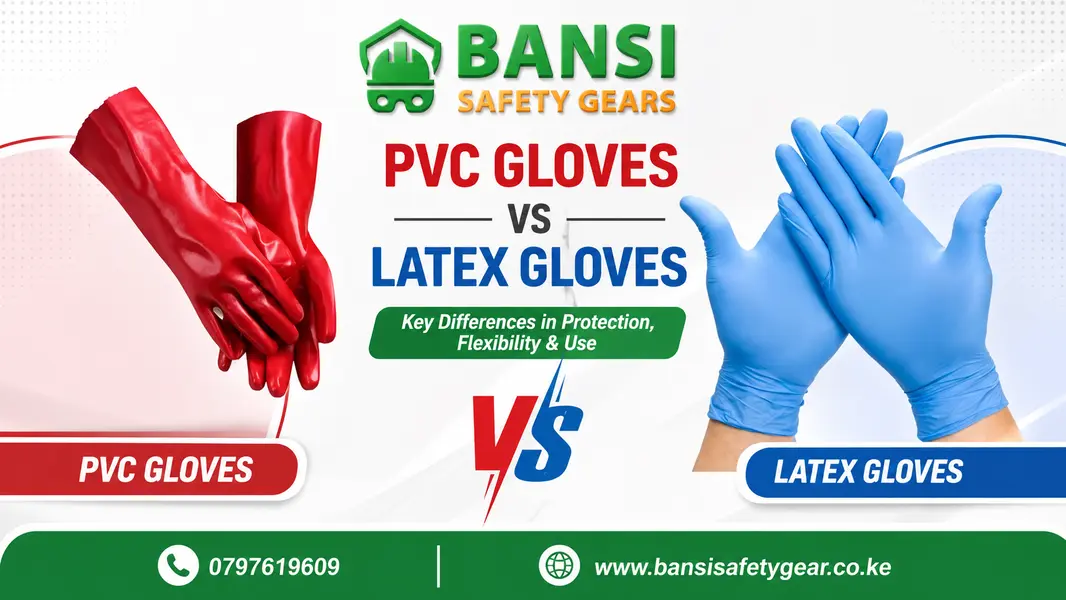
PVC Gloves vs Latex Gloves
PVC gloves and latex gloves are both used for hand protection, but they differ in material, flexibility, chemical performance, durability and common workplace applications. The right choice depends on the task, type of exposure, required dexterity, glove thickness and whether the glove will be reused or disposed of after use.
PVC gloves are made from polyvinyl chloride and are widely used for cleaning, wet work, maintenance and selected industrial applications. Latex gloves are made from natural rubber latex and are known for flexibility, close fit and good tactile sensitivity.
For a complete overview of PVC hand protection, visit our PVC Gloves in Kenya guide.
What Are PVC Gloves?
PVC gloves are protective gloves manufactured from or coated with polyvinyl chloride.
They are available in several forms, including:
- Red PVC gloves
- Long PVC gloves
- PVC gauntlet gloves
- Heavy-duty PVC gloves
- PVC coated work gloves
- Reusable PVC gloves
- Chemical-resistant PVC gloves for selected substances
PVC gloves are commonly considered for:
- Cleaning
- Wet work
- Industrial cleaning
- Maintenance
- Waste handling
- Agriculture
- Factory work
- Oil and grease handling
- Selected chemical applications
Explore our main PVC Gloves in Kenya resource for more information.
What Are Latex Gloves?
Latex gloves are manufactured from natural rubber latex.
Depending on their construction, they may be available as:
- Disposable latex gloves
- Reusable rubber cleaning gloves
- Heavy-duty latex gloves
- Long-cuff latex gloves
- Industrial rubber gloves
Latex is particularly valued for flexibility, elasticity and close-fitting hand movement.
Common applications may include:
- Cleaning
- General washing
- Healthcare applications where appropriate
- Laboratory work
- Food handling where approved
- General hygiene tasks
- Light industrial work
- Wet work
The exact glove specification should always be considered.
PVC Gloves vs Latex Gloves: Main Differences
| Feature | PVC Gloves | Latex Gloves |
|---|---|---|
| Material | Polyvinyl chloride | Natural rubber latex |
| Common format | Reusable, coated, long cuff | Disposable or reusable |
| Flexibility | Depends on construction | Generally very flexible |
| Dexterity | Moderate to good depending on thickness | Often excellent |
| Long-cuff options | Very common | Available |
| Heavy-duty options | Common | Available |
| Wet work | Common application | Common application |
| Industrial cleaning | Common | Depends on glove design |
| Chemical resistance | Depends on chemical | Depends on chemical |
| Latex allergy concern | No natural latex base | May affect latex-sensitive users |
| Reusability | Very common | Disposable and reusable options |
Neither glove type is automatically better for every application.
PVC Gloves vs Latex Gloves for Cleaning
Both PVC and latex gloves can be used for cleaning.
PVC Gloves for Cleaning
PVC gloves may be particularly useful for:
- Commercial cleaning
- Industrial cleaning
- Equipment washing
- Facility maintenance
- Wet work
- General housekeeping
- Waste-area cleaning
Long PVC gloves can provide additional wrist and lower-forearm coverage where splashing is expected.
Read our PVC Gloves for Cleaning Kenya guide.
Latex Gloves for Cleaning
Reusable latex or rubber cleaning gloves may be useful for:
- General cleaning
- Washing
- Surface cleaning
- Household-style cleaning
- Light commercial cleaning
Latex gloves may offer greater elasticity and close-fitting movement.
The correct option depends on the cleaning chemical and task.
PVC Gloves vs Latex Gloves for Industrial Cleaning
Industrial cleaning may involve:
- Machinery residues
- Grease
- Wet equipment
- Oils
- Industrial dirt
- Cleaning chemicals
PVC gloves are commonly available in long-cuff and heavy-duty designs that can be useful for demanding cleaning environments.
Explore our PVC Gloves for Industrial Cleaning Kenya guide.
Latex gloves can also be used for selected cleaning work, but lightweight disposable latex gloves should not automatically be treated as substitutes for heavy-duty industrial gloves.
PVC Gloves vs Latex Gloves for Wet Work
Both materials can be used in wet environments.
PVC gloves may be useful for:
- Equipment washing
- Industrial wet work
- Commercial cleaning
- Maintenance
- Agricultural washing
- Waste-area cleaning
Latex gloves may also provide a suitable moisture barrier when intact and appropriately designed.
For prolonged wet work, consider:
- Glove thickness
- Cuff length
- Coating coverage
- Grip
- Glove condition
- Duration of exposure
Visit our PVC Gloves for Water and Wet Work Kenya guide.
PVC Gloves vs Latex Gloves for Chemical Handling
Neither PVC nor latex should be considered universally chemical resistant.
Performance depends on:
- Exact chemical
- Concentration
- Duration of exposure
- Temperature
- Glove thickness
- Material formulation
- Manufacturer compatibility information
PVC may provide suitable protection against some substances, while latex may perform differently against others.
For chemical work, always select gloves based on the specific chemical rather than choosing by material name alone.
Read our Are PVC Gloves Chemical Resistant? guide.
Also explore our PVC Gloves for Chemical Handling Kenya page.
PVC Gloves vs Latex Gloves for Dexterity
Latex gloves are generally known for:
- High elasticity
- Close fit
- Finger sensitivity
- Flexibility
- Fine-handling ability
This can make suitable latex gloves useful for tasks requiring precise hand movement.
Heavy-duty PVC gloves are usually thicker and may provide less fine dexterity, although lighter PVC-coated designs can offer greater flexibility.
The right glove depends on how much finger movement the task requires.
PVC Gloves vs Latex Gloves for Long Cuff Protection
Long PVC gloves and gauntlets are widely used where additional wrist and forearm coverage is needed.
They may be useful for:
- Industrial cleaning
- Wet work
- Equipment washing
- Maintenance
- Waste handling
- Selected chemical applications
Explore our Long PVC Gloves Kenya and PVC Gauntlet Gloves Kenya pages.
Long latex or rubber gloves are also available, but actual cuff length should be compared product by product.
PVC Gloves vs Latex Gloves for Oil and Grease
Some PVC glove designs may be useful around oils and grease.
Typical applications may include:
- Machinery maintenance
- Factory servicing
- Handling greasy parts
- Workshop work
- Equipment cleaning
Latex performance around oils and other substances varies, so material compatibility should be checked.
For PVC-specific applications, visit our PVC Gloves for Oil and Grease Handling Kenya guide.
PVC Gloves vs Latex Gloves for Maintenance
PVC gloves may be useful for maintenance work involving:
- Dirt
- Water
- Grease
- Oils
- Machinery cleaning
- Equipment washing
Latex gloves may be useful for selected light maintenance or cleaning tasks where greater flexibility is needed.
However, neither material should automatically be used where workers face significant:
- Cut hazards
- Heat
- Welding hazards
- Electrical risks
- Puncture hazards
Read our PVC Gloves for Maintenance Work Kenya guide.
PVC Gloves vs Latex Gloves for Factory Workers
Factories may require different glove types across different departments.
PVC gloves may be useful for:
- Industrial cleaning
- Wet processing
- Maintenance
- General material handling
- Greasy environments
- Waste handling
Latex gloves may be more suitable for selected tasks requiring:
- Fine dexterity
- Close fit
- Light contamination control
- Frequent glove changes
Explore our PVC Gloves for Factory Workers Kenya guide.
PVC Gloves vs Latex Gloves for Agriculture
PVC gloves may be useful for suitable agricultural applications such as:
- Equipment washing
- Wet farm work
- Farm maintenance
- Cleaning
- Handling muddy materials
- General agricultural housekeeping
Latex gloves may be useful for selected lighter tasks requiring close fit or flexibility.
For pesticides and agricultural chemicals, neither material should be selected without checking compatibility with the exact product.
Read our PVC Gloves for Agriculture Kenya guide.
PVC Gloves vs Latex Gloves for Waste Handling
PVC gloves may be useful for selected waste-handling tasks involving:
- Wet waste
- Dirty bins
- General facility waste
- Waste-area cleaning
- Industrial housekeeping
Latex gloves may be used for selected light-duty applications but may not provide the durability required for demanding waste-handling environments.
Sharp materials, needles or hazardous waste may require specialized gloves.
Explore our PVC Gloves for Waste Handling Kenya guide.
PVC Gloves and Latex Allergy
One important difference between PVC and latex gloves is the possibility of sensitivity to natural rubber latex.
Some people can develop allergic reactions to proteins found in natural rubber latex.
PVC gloves are not made from natural rubber latex and may therefore be considered as an alternative where natural latex exposure needs to be avoided.
However, users with known allergies should still check the specific product composition and workplace requirements.
Which Is More Flexible: PVC or Latex?
Latex generally offers greater natural elasticity.
This can make latex gloves:
- Easier to stretch
- More form-fitting
- Better suited to detailed hand movements
PVC glove flexibility depends on formulation and thickness.
A thin PVC-coated work glove can be flexible, while a heavy-duty PVC gauntlet may feel considerably more rigid.
Which Is More Durable: PVC or Latex?
There is no universal answer because durability depends on glove construction.
A heavy-duty PVC glove may be more durable for industrial cleaning than a thin disposable latex glove.
A thick reusable latex glove may also offer good durability for suitable applications.
Compare:
- Thickness
- Abrasion exposure
- Intended use
- Chemical exposure
- Cleaning frequency
- Manufacturer guidance
For demanding PVC applications, explore our Heavy Duty PVC Gloves Kenya guide.
PVC Gloves vs Latex Gloves for Repeated Use
PVC gloves are commonly available as reusable work gloves.
They may be suitable for repeated:
- Cleaning
- Wet work
- Maintenance
- Industrial handling
- Equipment washing
Reusable latex gloves are also available.
In either case, gloves should be:
- Inspected
- Cleaned correctly
- Dried properly
- Stored appropriately
- Replaced when damaged
Explore our Reusable PVC Gloves Kenya page.
Disposable Latex Gloves vs Reusable PVC Gloves
These two products often serve very different purposes.
Disposable Latex Gloves
May be selected for:
- Short-duration work
- Frequent glove changes
- Fine dexterity
- Contamination-control tasks
- Close-fitting protection
Reusable PVC Gloves
May be selected for:
- Repeated wet work
- Industrial cleaning
- Maintenance
- Equipment washing
- Long-cuff protection
- Heavy-duty applications
This is why comparing glove type and construction is more useful than comparing only material names.
PVC Gloves vs Latex Gloves for Grip
Grip depends on surface design as much as material.
PVC gloves may feature:
- Textured surfaces
- Roughened coatings
- PVC dot patterns
- Coated palms
Latex gloves may also feature textured fingertips or palms.
For slippery, wet or oily work, always evaluate the actual glove’s grip characteristics.
PVC Coated Gloves vs Latex Gloves
PVC coated gloves are often designed for industrial handling rather than liquid immersion.
They may combine a fabric liner with PVC coating for:
- Grip
- Material handling
- Warehousing
- Maintenance
- Construction support
Explore our PVC Coated Gloves Kenya guide.
Latex gloves may offer greater flexibility but may serve a different type of task.
How to Choose Between PVC and Latex Gloves
Consider the following factors.
1. Identify the Task
Is the worker cleaning, handling materials, working with chemicals or performing fine tasks?
2. Identify the Hazard
Consider:
- Water
- Dirt
- Chemicals
- Oil
- Grease
- Contamination
- Mechanical hazards
3. Consider Dexterity
Fine work may benefit from a close-fitting glove.
4. Consider Cuff Length
Long gloves may be preferable where exposure extends above the wrist.
5. Check Chemical Compatibility
Never select chemical gloves based only on PVC or latex material names.
6. Consider Reusability
Determine whether the application requires disposable or reusable gloves.
7. Check for Latex Sensitivity
Where natural rubber latex sensitivity is a concern, an alternative material may need to be selected.
8. Check Fit and Grip
The glove should allow safe control of tools, containers and equipment.
For PVC-specific selection guidance, read our How to Choose PVC Gloves guide.
PVC Gloves vs Latex Gloves: Which Is Better?
Neither material is better for every task.
PVC gloves may be preferable for suitable:
- Heavy-duty cleaning
- Industrial wet work
- Long-cuff protection
- Equipment washing
- Maintenance
- General industrial applications
Latex gloves may be preferable for suitable tasks requiring:
- Greater elasticity
- Close fit
- High dexterity
- Fine hand movement
- Disposable glove use
The best selection process is:
Hazard → Task → Material Compatibility → Glove Construction → Coverage → Dexterity → Fit
Find PVC Gloves in Kenya
Bansi Safety Gear offers PVC gloves for cleaning, wet work, maintenance, industrial handling, factories, agriculture and selected chemical applications.
Available options may include:
- Red PVC gloves
- Long PVC gloves
- PVC chemical-resistant gloves
- Heavy-duty PVC gloves
- PVC gauntlet gloves
- PVC coated gloves
- Reusable PVC gloves
Visit our main PVC Gloves in Kenya resource to explore the complete PVC glove ecosystem.
Bansi Safety Gear – Gear Up. Stay Safe. Get It Done.





Leave a Reply