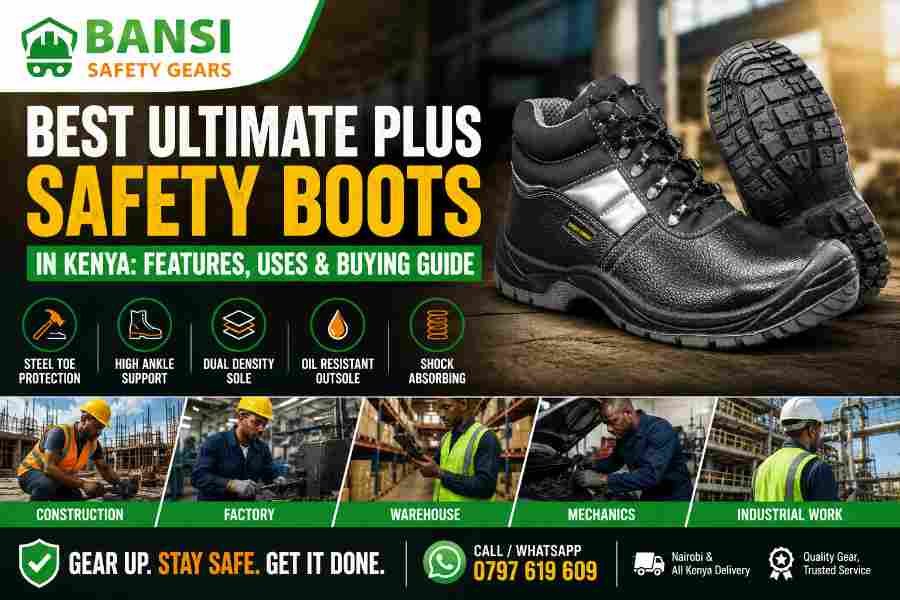
Best Ultimate Plus Safety Boots in Kenya Buying Guide
I’ve cleaned this Ultimate Plus guide the same way we handled Vaultex. The biggest issues were that it still contained internal SEO-cleanup language such as “older pages described…” and “there is no need to create separate products,” which should never appear to customers, and it repeated the full product specification too many times.
Use this as the replacement article:
How to Choose Ultimate Plus Safety Boots in Kenya – Buying Guide
Choosing the right Ultimate Plus safety boots in Kenya should begin with the work being performed, the hazards present and the protective footwear specification required.
Construction workers, factory employees, warehouse teams, mechanics, engineers and maintenance technicians can face very different foot hazards. The right safety boot should therefore match the worker’s duties, workplace conditions, required protection, correct size and documented product specification.
This guide explains the main Ultimate Plus safety-boot features, what they mean and how to determine whether the footwear is suitable for your workplace.
If you are ready to compare available products, sizes and current prices, browse our Ultimate Plus Safety Boots Kenya collection.
For detailed information about the featured model, view the Ultimate Plus Steel Toe Safety Boots.
What Are Ultimate Plus Safety Boots?
Ultimate Plus safety boots are protective industrial footwear intended for demanding professional working environments.
According to the manufacturer technical information for the featured Ultimate Plus model, the footwear incorporates:
- Buffalo leather upper
- 200 J steel toe protection
- Steel penetration-resistant midsole
- Penetration resistance above 1,000 N
- Compression protection of 11,000 N
- Dual-density PU/PU outsole
- EVA insole
- Manufacturer-stated antibacterial and antifungal insole properties
- Anti-static properties
- Heel energy absorption above 20 J
- EN ISO 20345:2011 referenced in the technical documentation
These characteristics describe different parts and performance features of the footwear.
They should be considered together when deciding whether the boot matches the workplace requirement.
Start With the Workplace Hazard
Do not choose Ultimate Plus safety boots based only on:
- Price
- Appearance
- Job title
- Brand name
- One protective feature
Start by identifying what the worker actually does and what hazards are present.
Consider:
Impact & Compression
Could materials, tools, components or equipment fall or move onto the worker’s feet?
Underfoot Hazards
Could employees step on:
- Nails
- Sharp metal
- Construction debris
- Fabrication waste
- Other penetrating objects
Workplace Surface
Will workers operate on:
- Concrete
- Workshop floors
- Factory floors
- Outdoor ground
- Warehouses
- Uneven surfaces
Working Duration
Does the employee spend most of the day:
- Standing
- Walking
- Moving stock
- Operating machinery
- Moving between departments
Workplace Conditions
Are there additional considerations involving:
- Water
- Oil
- Heat
- Chemicals
- Dust
- Other workplace substances
Once these factors are understood, you can compare the footwear specification more meaningfully.
Understanding the 200 J Steel Toe
The featured Ultimate Plus safety boot incorporates a steel protective toe cap.
The manufacturer’s technical information states 200 joules of impact protection and compression protection of 11,000 N.
Toe protection may be relevant where employees work around:
- Heavy materials
- Components
- Tools
- Equipment
- Stock
- Machinery
- Moving objects
However, a steel toe describes only the toe-protection feature.
It does not automatically establish:
- Penetration protection
- Electrical protection
- Waterproofing
- Chemical resistance
- Heat resistance
Check each required property separately.
Understanding the Steel Protective Midsole
The Ultimate Plus model also incorporates a steel penetration-resistant midsole.
The manufacturer states penetration resistance above 1,000 N.
This may be important where workers are exposed to sharp objects underfoot.
Examples can include:
- Construction debris
- Nails
- Metal offcuts
- Workshop waste
- Fabrication material
The protective midsole should not be confused with the steel toe.
Steel toe helps protect the toe area.
Steel midsole addresses relevant penetration hazards from below.
What Does Dual Density Mean?
The Ultimate Plus boot uses a dual-density PU/PU outsole.
Dual density describes the construction of the sole system.
It does not describe the toe protection.
A safety boot can therefore be both:
Steel toe
and
Dual density
at the same time.
The featured Ultimate Plus model incorporates both features.
Dual-density construction can provide a practical balance between cushioning and workplace durability, although comfort still depends on:
- Correct size
- Foot shape
- Fit
- Insole
- Worker duties
- Walking duration
- Standing duration
- Workplace surface
Steel Toe vs Dual Density Safety Boots
Steel toe and dual density refer to completely different parts of a safety boot.
Steel Toe
Describes the protective toe-cap system.
Dual Density
Describes the construction of the outsole.
Neither term should be treated as a complete description of the footwear.
When comparing Ultimate Plus safety boots, review the full specification rather than choosing a product based on a single feature.
Buffalo Leather Upper
The featured Ultimate Plus boot uses a buffalo leather upper.
Leather can provide a durable outer construction for industrial footwear when maintained appropriately.
Workers should regularly inspect leather safety boots for:
- Cuts
- Cracking
- Serious abrasion
- Separation
- Damaged seams
- Contamination
- Other deterioration
Footwear should be removed from service where damage could affect its protective function.
EVA Insole
The manufacturer specifies an EVA insole.
The technical information also describes the insole as having antibacterial and antifungal properties.
The insole contributes to the internal footbed and wearing experience.
Workers should still follow appropriate footwear hygiene practices and allow footwear to dry properly where necessary.
Heel Energy Absorption
The Ultimate Plus technical information states heel energy absorption above 20 J.
This can be a useful footwear characteristic for employees who spend significant periods walking or standing during the workday.
However, no single specification guarantees comfort for every worker.
Correct sizing and fit remain important.
Anti-Static Properties
The manufacturer documentation identifies the featured Ultimate Plus footwear as having anti-static properties.
Anti-static performance should be considered within the wider workplace safety system.
Factors such as footwear condition, moisture, contamination and workplace surfaces may affect practical performance.
Anti-static footwear should also not automatically be described as electrical-hazard footwear.
Where specialist electrical protection is required, verify the applicable footwear specification separately.
High-Ankle Work Boot Design
Ultimate Plus safety boots use a higher-cut design than low-cut safety shoes.
High-ankle footwear provides more coverage around the ankle area and may be preferred for selected:
- Construction activities
- Engineering work
- Workshops
- Maintenance
- Manufacturing
- Industrial environments
Boot height alone does not determine protective performance.
The appropriate design should still match:
- Worker duties
- Workplace hazards
- Required protection
- Fit
- Employer requirements
For lower-cut protective footwear, compare our Safety Shoes in Kenya options.
How to Choose Ultimate Plus Safety Boots
Use this process before ordering.
1. Identify the Work
Understand what the employee actually does during a normal working day.
A job title alone is not enough.
2. Identify the Hazards
Consider impact, penetration, floor conditions, substances and environmental exposure.
3. Determine Required Toe Protection
Where impact or compression hazards exist, establish the required toe protection.
4. Check Whether Penetration Protection Is Needed
Where workers may step on sharp objects, confirm the required underfoot protection.
5. Assess the Workplace Surface
Consider whether employees work on concrete, workshop floors, factory surfaces, uneven ground or other conditions.
6. Consider Work Duration
Employees who walk or stand throughout long shifts should pay close attention to fit, sole construction and sizing.
7. Choose the Appropriate Boot Height
Determine whether high-ankle footwear is appropriate for the work.
8. Check Required Standards
If an employer, tender, contractor or project specifies a footwear standard, compare it with the exact model documentation.
9. Confirm Correct Size
Footwear needs to fit the individual worker properly.
10. Compare Price
Compare prices only after identifying footwear that meets the required specification.
A useful sequence is:
Job → Hazard → Required Protection → Specification → Fit → Price
Choosing Ultimate Plus Boots by Workplace
Different workplaces can require different footwear considerations.
| Workplace | Important considerations |
|---|---|
| Construction | Toe protection, penetration protection, outsole, fit |
| Manufacturing | Toe protection, standing, floor conditions, machinery |
| Warehouse | Fit, walking duration, toe protection, floor surface |
| Workshop | Toe protection, midsole, working surface, contaminants |
| Maintenance | Walking, tools, workplace environment, protection |
| Engineering | Site requirements, hazards, specification, fit |
These are general buying considerations rather than automatic recommendations.
Ultimate Plus Boots for Construction
Construction workers can face hazards involving:
- Building materials
- Tools
- Sharp debris
- Falling objects
- Machinery
- Rough site surfaces
When considering Ultimate Plus footwear for construction, check:
- Toe protection
- Underfoot penetration protection
- Boot height
- Sole construction
- Correct worker size
- Site PPE specification
The featured model incorporates documented 200 J steel toe protection, a protective steel midsole and buffalo leather construction.
It may be suitable where these characteristics match the project’s identified requirements.
For complete site PPE, visit Construction PPE Kenya.
Ultimate Plus Boots for Manufacturing
Manufacturing environments can contain very different jobs.
Footwear requirements may vary between:
- Production workers
- Machine operators
- Engineers
- Maintenance technicians
- Stores teams
- Warehouse employees
- Supervisors
Relevant considerations can include:
- Machinery
- Materials
- Hard floor surfaces
- Impact hazards
- Penetration hazards
- Standing duration
- Walking duration
The correct safety boot should be matched to the actual task rather than simply described as a factory boot.
Ultimate Plus Boots for Warehouses & Logistics
Warehouse workers may spend much of their shift:
- Walking
- Standing
- Picking
- Packing
- Receiving
- Loading
- Dispatching
They may also work around:
- Pallets
- Forklifts
- Stock
- Material-handling equipment
- Loading areas
Important footwear considerations include:
- Toe protection
- Correct fit
- Sole construction
- Walking duration
- Floor surface
- Underfoot hazards
The featured Ultimate Plus boot’s steel toe, protective midsole, dual-density sole and heel-energy-absorption characteristics may be relevant where these features match the workplace requirement.
Ultimate Plus Boots for Mechanics & Workshops
Workshop employees may work around:
- Tools
- Machinery
- Vehicle components
- Metal parts
- Hard floors
- Industrial equipment
Their footwear should be selected according to those actual hazards.
Consider:
- Toe protection
- Underfoot hazards
- Outsole
- Correct size
- Workplace contaminants
- Required standards
Do not assume footwear is resistant to every oil, fuel or chemical unless the exact product documentation supports that claim.
Are Ultimate Plus Boots Suitable for Long Working Hours?
Workers wearing protective footwear throughout full shifts should consider both protection and fit.
Important factors include:
- Correct size
- Toe room
- Heel fit
- Ankle fit
- Lacing
- Insole
- Sole construction
- Boot weight
- Walking duration
- Standing duration
- Workplace surface
The featured Ultimate Plus model includes an EVA insole, dual-density PU/PU outsole and manufacturer-documented heel energy absorption.
These features should be assessed together with the worker’s individual fit.
How Should Ultimate Plus Safety Boots Fit?
A safety boot should feel secure without unnecessary pressure.
When checking fit:
- Wear your normal work socks
- Check that the toes have appropriate room
- Confirm the heel does not move excessively
- Lace the boot securely
- Check the ankle area
- Walk in the footwear where possible
- Check for unusual pressure points
Do not automatically select an oversized boot simply to create more room.
Buying for Several Employees
Companies should obtain individual employee sizes before ordering.
A simple size schedule can show:
- Size
- Quantity required
For workforce orders, visit our Bulk Safety Boots Supplier in Kenya page.
Ultimate Plus Safety Boots Technical Specification
The featured Ultimate Plus safety boot has the following manufacturer-stated characteristics:
| Specification | Ultimate Plus Safety Boot |
|---|---|
| Upper | Buffalo leather |
| Toe protection | Steel toe |
| Impact protection | 200 J |
| Compression protection | 11,000 N |
| Midsole | Steel |
| Penetration resistance | Above 1,000 N |
| Outsole | Dual-density PU/PU |
| Insole | EVA |
| Insole properties | Antibacterial and antifungal stated by manufacturer |
| Heel energy absorption | Above 20 J |
| Anti-static | Manufacturer specified |
| Standard referenced | EN ISO 20345:2011 |
Always check the exact footwear supplied against any mandatory employer, project or tender specification.
Does Ultimate Plus Meet EN ISO 20345?
The manufacturer technical information for the featured Ultimate Plus footwear references EN ISO 20345:2011.
Do not automatically interpret a general standard reference as a specific footwear classification such as:
- S1
- S1P
- S2
- S3
unless that classification is specifically documented for the exact model.
This is particularly important for procurement, tender and compliance requirements.
How to Compare Ultimate Plus Models
When comparing Ultimate Plus footwear, review:
- Exact model
- Toe protection
- Midsole protection
- Outsole construction
- Upper material
- Boot height
- Insole
- Anti-static properties
- Documented standards
- Available size
- Current price
Avoid comparing only product titles.
Different phrases such as:
- Steel toe
- Dual density
- High ankle
- Comfortable work boot
may describe different features of one physical safety boot rather than separate models.
The exact product specification should be the primary reference.
Ultimate Plus Safety Boots Price in Kenya
The Ultimate Plus safety boots price in Kenya can vary according to current stock, product model, size and supplier pricing.
Price should be considered only after confirming that the footwear meets the workplace requirement.
Use this sequence:
Hazard → Required Protection → Suitable Product → Specification → Fit → Price
Browse the Ultimate Plus Safety Boots Kenya category for current products and displayed prices.
For broader comparisons, read our Safety Boots Price in Kenya 2026 guide.
Cheap vs Suitable Safety Boots
The cheapest boot is not automatically the best value.
Likewise, a more expensive product is not automatically more appropriate.
Compare footwear according to:
- Workplace hazards
- Protective requirements
- Exact specification
- Correct fit
- Worker duties
- Work environment
- Required standard
- Price
For PPE purchasing, suitability should come before price.
When Should Ultimate Plus Safety Boots Be Replaced?
Inspect safety footwear regularly.
Consider replacement if there is:
- Excessive outsole wear
- Serious cracking
- Sole separation
- Significant leather damage
- Damage around the protective toe
- Penetration damage
- Damaged fastening systems
- Serious contamination
- Any deterioration that may affect protection
There is no single replacement period suitable for every worker.
Footwear condition, workplace exposure, usage frequency and manufacturer guidance should all be considered.
Where to Buy Ultimate Plus Safety Boots in Kenya
Bansi Safety Gear supplies Ultimate Plus workplace footwear for individual, company, contractor and project requirements.
To compare current Ultimate Plus options, browse our Ultimate Plus Safety Boots Kenya collection.
To view the featured footwear directly, see the Ultimate Plus Steel Toe Safety Boots product page.
For alternative brands and styles, browse our complete Safety Boots in Kenya category.
Frequently Asked Questions About Ultimate Plus Safety Boots
How do I choose Ultimate Plus safety boots?
Start with the worker’s job and workplace hazards. Determine the required protection, confirm the exact footwear specification and size, then compare suitable options and prices.
Are Ultimate Plus safety boots steel toe?
The featured model has manufacturer-documented 200 J steel toe protection.
Do Ultimate Plus safety boots have a steel midsole?
The featured model has a manufacturer-specified steel penetration-resistant midsole with resistance above 1,000 N.
What does dual density mean?
Dual density refers to the construction of the sole. The featured Ultimate Plus model uses a dual-density PU/PU outsole.
Is steel toe the same as dual density?
No. Steel toe describes the protective toe cap. Dual density describes sole construction. A single safety boot can have both.
Are Ultimate Plus boots anti-static?
Anti-static properties are documented for the featured model.
Are Ultimate Plus boots suitable for construction?
They may be suitable where the footwear’s documented features match the construction site’s hazards and PPE requirements.
Are Ultimate Plus boots suitable for warehouses?
They may be suitable where their protection, fit and sole characteristics match the employee’s duties and workplace hazards.
Are Ultimate Plus boots suitable for mechanics?
They can be considered where the documented protection matches the hazards present in the workshop or mechanical environment.
Are Ultimate Plus safety boots waterproof?
Do not assume waterproof performance unless it is specifically documented for the exact footwear model.
Are Ultimate Plus boots chemical resistant?
Do not assume broad chemical resistance unless manufacturer documentation supports the exact chemical and exposure conditions.
What standard do Ultimate Plus safety boots meet?
The manufacturer technical documentation for the featured model references EN ISO 20345:2011.
What is the price of Ultimate Plus safety boots in Kenya?
Prices depend on the exact product and current availability. Check the Ultimate Plus Safety Boots category or individual product page for the current displayed price.
Compare Ultimate Plus Safety Boots in Kenya
There is no single work boot that is automatically right for every employee.
Use this buying process:
Job → Hazard → Required Protection → Specification → Fit → Price
When you understand the worker’s requirements, browse our Ultimate Plus Safety Boots Kenya collection to compare current options.
For the featured product, view the Ultimate Plus Steel Toe Safety Boots.
For other brands, return to our main Safety Boots in Kenya category.
Bansi Safety Gear — Gear Up. Stay Safe. Get It Done.

Leave a Reply