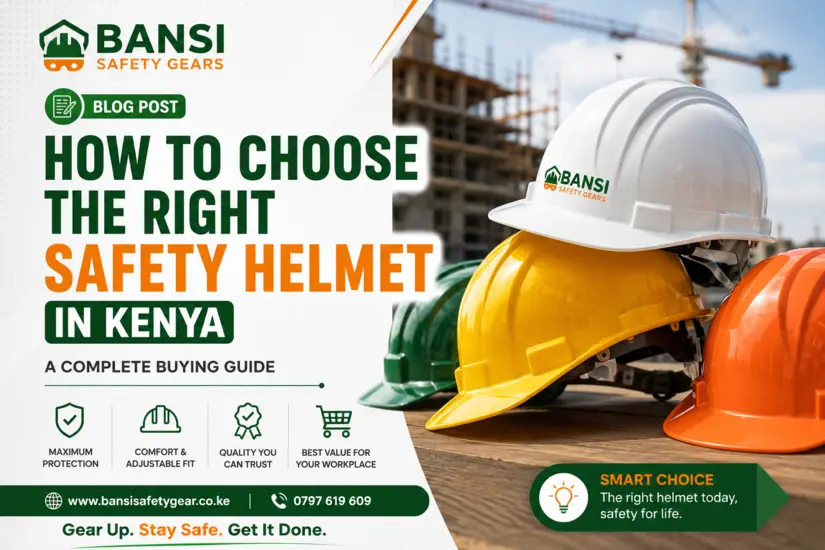
How to Choose the Right Safety Helmet in Kenya
Choosing the right safety helmet in Kenya starts with the workplace hazard—not colour, appearance or price.
Construction sites, factories, warehouses, engineering projects, maintenance teams and utility operations can expose workers to very different head hazards. A helmet suitable for one job should not automatically be assumed suitable for another.
The safest buying sequence is:
Work Activity → Head Hazard → Helmet Type → Exact Specification → Fit → Retention → Ventilation → PPE Compatibility → Inspection → Price
This guide explains how to work through each step before buying.
For current products, colours and prices, browse our Safety Helmets in Kenya collection.
Why Choosing the Right Safety Helmet Matters
Workers may encounter head hazards such as:
- Falling tools
- Building materials
- Overhead structures
- Accidental impact
- Maintenance work
- Material handling
- Moving equipment
- Elevated work
- Other workplace-specific hazards
The purpose of helmet selection is not simply to give every worker a hard hat.
The helmet should match the actual hazard, working environment and required specification.
Before purchasing, check the workplace risk assessment together with the exact manufacturer’s product information.
What Is a Safety Helmet?
A safety helmet, commonly called a hard hat, is a form of personal protective equipment designed to help protect the head against appropriate workplace hazards.
A typical industrial helmet can include:
Outer Shell
The outer shell forms the main external protective structure.
Internal Suspension or Cradle
The internal suspension helps position the helmet on the wearer’s head and forms part of the helmet’s protective system.
Adjustment System
The adjustment system allows the helmet to be fitted to the individual worker.
Retention Components
Some applications may require a compatible chin strap or another suitable retention system.
Different helmet designs use different components, so check the exact model rather than assuming every hard hat is constructed identically.
Step 1: Identify the Work Activity
Start by asking what the employee actually does.
Examples include:
- General construction
- Scaffolding
- Roofing
- Manufacturing
- Warehousing
- Engineering
- Maintenance
- Telecom work
- Utilities
- Solar installation
- Contractor work
- Site inspection
Job titles alone are not enough.
Two people working for the same company may require different head protection because their activities and hazards are different.
Step 2: Identify the Head Hazard
Consider what could actually injure the worker’s head.
Possible hazards include:
- Falling objects
- Overhead materials
- Accidental contact with structures
- Low-clearance objects
- Flying debris
- Elevated work
- Specialist electrical hazards
- Other task-specific risks
This step helps determine whether the worker needs an industrial safety helmet, bump cap, work-at-height helmet or another specialist product.
Step 3: Choose the Correct Type of Head Protection
Different head-protection products serve different purposes.
Standard Industrial Safety Helmets
Standard industrial helmets are commonly used for suitable:
- Construction work
- Manufacturing
- Engineering
- Maintenance
- Industrial operations
- Infrastructure projects
Their exact suitability depends on the individual model and workplace requirement.
Ratchet Safety Helmets
Ratchet helmets use an adjustment mechanism that allows the worker to tighten or loosen the fit around the head.
Advantages can include:
- Convenient adjustment
- Easier individual fitting
- Quick adjustment during use
A ratchet system is primarily a fit feature.
It should not automatically be interpreted as greater protective performance.
Vented Safety Helmets
Vented helmets contain openings intended to improve airflow.
They may be useful where:
- Heat is a concern
- Workers spend long periods outdoors
- The working environment is warm
- Improved airflow is desirable
Ventilation does not determine the helmet’s complete safety specification.
Where electrical or other specialist protection is required, verify the exact helmet documentation.
Non-Vented Safety Helmets
Non-vented helmets use a more closed shell design.
They may be preferred for certain workplaces, but a closed shell should not automatically be described as electrically protective.
Electrical suitability must be established from the exact helmet specification.
Work-at-Height Helmets
Roofing, scaffolding, telecom towers, solar installation and elevated maintenance can involve additional considerations such as:
- Climbing
- Increased worker movement
- Helmet retention
- Different working positions
- Project-specific requirements
A standard construction helmet and a specialist work-at-height helmet should not automatically be treated as interchangeable.
Browse our Work-at-Height Helmets within the Safety Helmets range where elevated work is involved.
Remember:
A helmet protects the head. It does not arrest a fall.
Fall hazards may require suitable harnesses, anchorage, connectors and other Safety Harnesses in Kenya.
Safety Helmet vs Bump Cap
A bump cap and an industrial safety helmet are different products.
Bump Cap
May be suitable where the main hazard is accidentally striking the head against a fixed object such as:
- Shelving
- Low beams
- Machinery
- Vehicle interiors
- Pipework
Safety Helmet
May be required where hazards include falling objects or more significant workplace head-impact risks.
Do not select a bump cap simply because it is lighter or more comfortable where the risk assessment requires helmet-level protection.
Browse our Bump Caps in Kenya for suitable low-level fixed-object applications.
Step 4: Check the Exact Helmet Specification
Do not select a helmet solely because the website title says:
- Industrial helmet
- Construction helmet
- Heavy-duty helmet
- Electrical helmet
- Professional helmet
Check the exact model documentation.
Depending on the requirement, look for information such as:
- Applicable standard
- Manufacturer
- Model number
- Helmet material
- Size range
- Temperature markings
- Additional performance markings
- Instructions for use
Do not assume every helmet from one brand carries identical performance characteristics.
Safety Helmet Standards
Safety standards help define tested helmet requirements.
Depending on the exact product and workplace requirement, buyers may encounter references such as:
- EN 397
- EN 50365
- ANSI/ISEA Z89.1
- Other relevant product standards
Do not assume every helmet sold in Kenya complies with every standard.
Where a company, contractor, tender or project specifies a particular standard, confirm the exact helmet model and supporting documentation before purchasing.
Step 5: Check Helmet Fit
A helmet should fit securely on the individual worker.
Check that:
- The headband adjusts correctly
- The helmet sits securely
- It is not excessively loose
- It does not create unnecessary pressure points
- Normal movement does not easily dislodge it
- The worker can wear it correctly throughout the intended task
One helmet size should not simply be assumed to fit every employee equally well.
Ratchet vs Pin-Lock Helmet Adjustment
Different helmet models can use different adjustment systems.
Ratchet Adjustment
A ratchet system can allow quicker adjustment around the head.
It may be useful where:
- Helmets are worn frequently
- Workers need convenient fit adjustment
- Individual fitting is important
Pin-Lock Adjustment
A pin-lock system uses fixed adjustment positions.
It can provide a simple way to set the helmet size where frequent readjustment is not required.
Neither system should automatically be considered safer simply because of the adjustment mechanism.
Compare the entire helmet specification.
Step 6: Consider Retention Requirements
Some work activities may require stronger consideration of helmet retention.
For example:
- Roofing
- Scaffolding
- Tower work
- Climbing
- Elevated maintenance
may involve more worker movement than ordinary ground-level activities.
Where a chin strap or retention system is required, use one that is compatible with the exact helmet.
Do not improvise by attaching an unsuitable strap.
Step 7: Choose Between Vented and Non-Vented Helmets
Ventilation affects comfort, but it should not be the only selection factor.
Consider a Vented Helmet When
- Workers operate in warm conditions
- Improved airflow is useful
- The exact helmet is suitable for the identified hazard
Consider a Non-Vented Helmet When
- A closed-shell design is appropriate
- The workplace specification requires it
- The exact manufacturer documentation supports the application
Do not assume:
Vented = unsafe
or
Non-vented = electrically safe
The exact helmet specification determines suitability.
Step 8: Consider Helmet Colour
Safety helmets are available in colours such as:
- White
- Yellow
- Blue
- Green
- Red
- Orange
Companies may use helmet colours to identify:
- Workers
- Supervisors
- Engineers
- Contractors
- Visitors
- Maintenance teams
- Safety personnel
- Emergency teams
However, helmet colour meanings are not universal standards.
For example, some companies may use blue for technicians while another organisation assigns blue to a completely different group.
The colour does not determine protective performance.
Therefore:
Blue does not automatically mean electrical protection.
Green does not automatically mean safety-officer protection.
Red does not automatically mean firefighting protection.
Choose the required helmet specification first, then choose the colour according to your organisation’s identification policy.
Step 9: Check Compatibility With Other PPE
Workers may need to wear a safety helmet together with:
- Ear muffs
- Face shields
- Visors
- Safety goggles
- Respirators
- Welding protection
- Chin straps
- Other head-mounted equipment
Compatibility should be confirmed rather than improvised.
Only use accessories that are suitable for the exact helmet system.
Avoid drilling, cutting or making unauthorised modifications to a safety helmet.
Safety Helmets With Hearing Protection
Some helmet models can accept compatible helmet-mounted ear defenders.
Before combining them, confirm:
- Helmet accessory slots
- Ear-muff compatibility
- Correct attachment system
- Workplace noise-protection requirements
Do not assume any helmet-mounted earmuff will fit every helmet.
Safety Helmets With Face Shields
Selected helmets may support compatible:
- Face shields
- Visors
- Eye-protection accessories
Confirm compatibility with the exact helmet before ordering.
A face shield also protects different hazards from the helmet itself, so each PPE item should be selected for its intended purpose.
Step 10: Inspect the Helmet Before Use
Safety helmets should be inspected according to manufacturer instructions and workplace procedures.
Check areas such as:
- Outer shell
- Suspension
- Headband
- Adjustment mechanism
- Chin strap
- Accessory points
- Other helmet components
Look for:
- Cracks
- Significant scratches
- Deformation
- Damaged suspension
- Loose components
- Deterioration
- Evidence of significant impact
- Missing parts
A damaged helmet should not remain in service simply because it still looks wearable.
When Should a Safety Helmet Be Replaced?
There is no single replacement interval that should automatically be applied to every helmet.
Follow the manufacturer’s instructions for the exact product.
Earlier replacement may be required where a helmet:
- Has sustained a significant impact
- Has a damaged shell
- Has damaged suspension
- Has deteriorated
- Has been exposed to unsuitable chemicals
- No longer fits or functions correctly
- Otherwise fails inspection
Do not rely only on age.
Condition and manufacturer guidance matter.
Common Mistakes When Choosing Safety Helmets
Avoid these common procurement mistakes:
Buying Only by Price
The cheapest helmet is not automatically suitable for every task.
Choosing by Colour
Colour helps identification but does not determine protection.
Assuming All Helmets Are the Same
Two helmets with a similar appearance can have different specifications.
Assuming Brand Equals Certification
Different models from the same brand can carry different specifications.
Assuming Non-Vented Means Electrical Protection
Electrical suitability requires exact-model verification.
Ignoring Fit
An incorrectly fitted helmet may not remain correctly positioned during work.
Using Incompatible Accessories
Only use suitable accessories designed for the helmet system.
Ignoring Manufacturer Instructions
Inspection, cleaning, storage and replacement instructions should be followed.
Choosing Safety Helmets for Construction
Construction sites can expose workers to:
- Falling tools
- Building materials
- Scaffolding
- Overhead work
- Structural components
- Accidental impact
The correct helmet should match the site’s hazard assessment and project requirements.
For broader site PPE, visit Construction PPE Kenya.
Choosing Safety Helmets for Factories
Factories may require head protection in selected:
- Production areas
- Engineering departments
- Maintenance zones
- Stores
- Loading areas
- Contractor areas
Different sections can require different PPE.
Do not assume the same helmet is appropriate for every employee in the facility.
Choosing Head Protection for Warehouses
Warehouse hazards can vary.
Some areas may involve:
- Racking
- Overhead materials
- Maintenance work
- Loading operations
- Construction activities
and may require industrial safety helmets.
Other areas where the main hazard is contact with fixed objects may be more suited to bump caps.
The workplace risk assessment should determine the correct choice.
Safety Helmet Price in Kenya
Price should be considered after suitability.
The safety helmet price in Kenya can vary according to:
- Brand
- Model
- Adjustment system
- Helmet design
- Technical specification
- Accessories
- Stock
- Quantity
For detailed pricing, visit our Safety Helmet Price in Kenya guide.
For current products and live displayed prices, browse Safety Helmets in Kenya.
Buying Safety Helmets in Bulk
Companies purchasing helmets for several workers should prepare a clear requirement before requesting quotation.
Include:
- Required helmet type
- Quantity
- Required colours
- Quantity per colour
- Adjustment system where specified
- Required safety standard
- Accessories
- Workplace application
- Delivery location
- Required date
For example:
Yellow – 80 helmets
White – 15 helmets
Blue – 20 helmets
These colour assignments are examples only.
Each organisation should establish its own helmet-colour policy.
Request a PPE Quotation for company and project quantities.
Safety Helmet Buying Checklist
Before placing an order, confirm:
- What work will the employee perform?
- What head hazard exists?
- Is a safety helmet the correct type of protection?
- Is a specialist work-at-height helmet required?
- What standard does the project require?
- Does the exact model support that requirement?
- Does the helmet fit correctly?
- Is appropriate retention required?
- Should the helmet be vented or non-vented?
- Is it compatible with other PPE?
- What colour does the organisation require?
- Has the helmet been inspected?
- What is the current price?
- Is supporting documentation required?
If these questions cannot be answered, obtain more information before purchasing.
Frequently Asked Questions
Which safety helmet is best for construction?
There is no single helmet that is automatically best for every construction site. Select according to the site’s hazards, required specification, fit and manufacturer documentation.
Should I choose a vented or non-vented helmet?
It depends on the working environment and exact hazard. Vented designs can improve airflow, while non-vented helmets use a more closed shell. Verify the exact product specification.
Is a ratchet helmet better than a standard helmet?
A ratchet mechanism makes fit adjustment convenient, but it does not by itself establish higher protective performance.
What helmet colour should construction workers wear?
Companies can establish their own colour system. There is no universal helmet-colour rule that applies to every workplace.
Does a blue helmet mean electrical protection?
No. Electrical suitability must be established from the exact helmet specification and relevant documentation.
Can a bump cap replace a safety helmet?
Not where the identified hazard requires industrial helmet-level protection.
Do workers at height need a different helmet?
Some elevated work may require a helmet with different retention or application-specific characteristics. Check the exact task and project requirements.
Can I attach any chin strap to a safety helmet?
No. Use compatible retention equipment intended for the exact helmet.
How often should a safety helmet be inspected?
Inspect it according to manufacturer instructions and workplace procedures, including before use where required.
Should I replace a helmet after impact?
Follow the exact manufacturer’s instructions. A significant impact may require replacement even where damage is not immediately obvious.
How much is a safety helmet in Kenya?
Prices vary by model, design, specification and quantity. Check the current Safety Helmets category or our dedicated price guide.
Can companies order helmets in bulk?
Yes. Companies, contractors, institutions and projects can submit quantities, colours and required specifications for quotation.
Choose the Right Safety Helmet in Kenya
Choosing the right safety helmet in Kenya should begin with the workplace hazard and required protection.
Use this process:
Work Activity → Hazard → Helmet Type → Specification → Fit → Retention → Ventilation → Compatibility → Inspection → Price
Do not make the decision based solely on:
- Price
- Colour
- Brand
- Appearance
For current products, browse Safety Helmets in Kenya.
For broader head protection, visit Head Protection Equipment in Kenya.
For pricing guidance, read Safety Helmet Price in Kenya.
For company and project quantities, Request a PPE Quotation.
Bansi Safety Gear — Gear Up. Stay Safe. Get It Done.


Comment (1)
[…] Read How to Choose the Right Safety Helmet […]